FEDERAL MINISTRY OF HEALTH
Influencing Policy and Supporting Change for Sound Nutrition Policies in Ethiopia
The Ethiopian government's focus on nutrition began in the decades following the devastating famine of the 1980s, which claimed the lives of more than 700,000 Ethiopians.
2016 · 4 pages
Sign in to readA free account is required to download.
Abstract
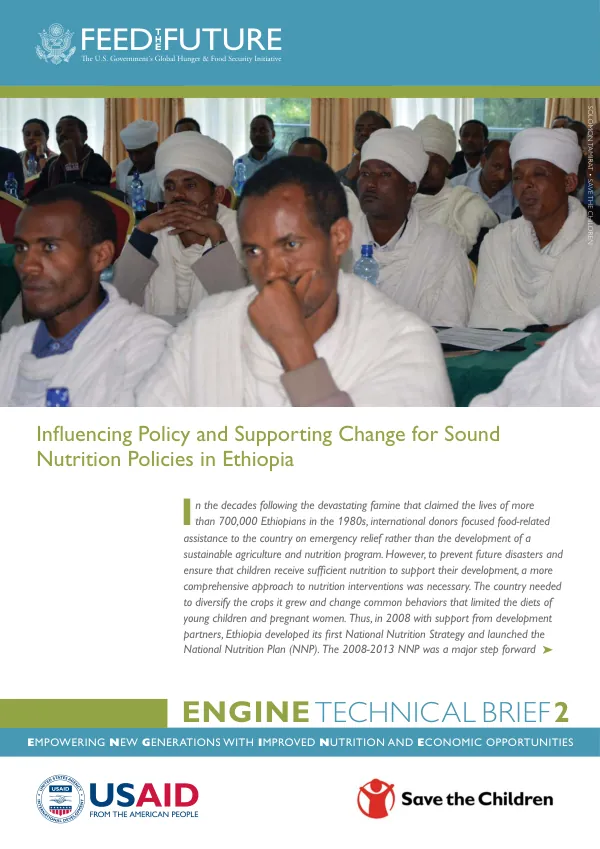
International donors initially focused on emergency relief rather than sustainable agriculture and nutrition programs. However, to prevent future disasters and ensure children receive sufficient nutrition, a comprehensive approach to nutrition interventions was necessary. In 2008, with support from development partners, Ethiopia developed its first National Nutrition Strategy and launched the National Nutrition Plan (NNP). The 2008-2013 NNP was a major step forward toward ending under-nutrition in Ethiopia and set the stage for the design and implementation of comprehensive nutrition projects. The U.S. Agency for International Development (USAID) designed the Empowering New Generation to Improve Nutrition and Economic opportunities (ENGINE) program to build capacity for the delivery of nutrition services and bolster the policies and structures responsible for shaping Ethiopia's nutrition program. ENGINE participated in the revision and design of the country's national nutrition policies and program, and provided technical support to the Ministry of Health (MOH), the Ministry of Agriculture (MOA), and other government bodies. In 2011, the Government of Ethiopia (GOE) requested ENGINE's assistance in reviewing and revising the NNP to align its implementation timeline with the Health Sector Development Plan and the Growth and Transformation Plan-I (2010-2015). The revised NNP emphasized the importance of multisectoral implementation, with each sector involved in implementation clearly articulating its responsibility. The program also recognized the unique needs of women of child-bearing age, infants, and children, emphasizing the first 1,000 days of life, as well as those of adolescents and the elderly. ENGINE successfully championed the inclusion of these key concepts in the 2012 plan. To support the implementation of the NNP, ENGINE worked with the Federal Ministry of Health (FMOH) and Regional Nutrition Technical Committees to introduce the multisectoral approach, the concept of nutrition-sensitive agriculture, and the 1,000 days concept through workshops at each level of government. The MOA's commitment to implementing the NNP and the inclusion of nutrition activities in several other government plans demonstrated the agricultural and other sectors' increased understanding of the importance of nutrition. ENGINE supported the development of a strategic plan to guide the MOA's implementation of the NNP. The MOA's second Agricultural Growth Program (AGP-II, 2016-2020) prominently featured support to "improve the diversity and nutritional content of smallholder production and processing" as a cross-cutting theme in each of its five components. The 2014 Productive Safety Net Program IV (PSNP IV), Ethiopia's social security program, incorporated nutrition in its interventions, which were traditionally focused on food security. The Government of Ethiopia established a multisectoral National Nutrition Coordinating Body (NNCB) in 2010 to support the implementation of the NNP. However, the NNCB did not have clear terms of reference or accountability, and it met only twice before ENGINE's launch. ENGINE and other development partners revitalized the NNCB, and the government's goal was to facilitate cooperation and collaboration for nutrition activities across sectors. ENGINE and UNICEF organized a capacity-building workshop in each of the four ENGINE-supported regions to explain the basics of nutrition, nutrition-sensitive approaches in non-health sectors, and the multi-sectoral approach to nutrition. To further encourage cooperation and support for nutrition interventions, ENGINE partnered with FMOH, UNICEF, and the World Food Program to arrange exchange visits to Uganda and Brazil for members of the national and regional technical and coordinating bodies. The Ethiopian delegates were particularly impressed by the system in Brazil, where many sectors work together in support of nutrition services, and the body overseeing nutrition programs reports directly to the president's office. The Ethiopian delegates drafted terms of reference for the development of a combined nutrition and food policy and a proposal to make the NNCB accountable to the prime minister's office and the regional coordinating bodies accountable to their respective regional presidents' offices. ENGINE collaborated with UNICEF and the USAID-funded FANTA III project to organize a two-day workshop for 58 parliamentarians in March 2014. The workshop introduced the politicians to the magnitude of childhood stunting and its devastating effects in Ethiopia, using statistics from the Cost of Hunger study conducted by the Ethiopian Public Health Institute and The Economic Commission for Africa (ECA). The parliamentarians developed action plans with activities such as educating other parliamentarians, including nutrition in sector plans, and allocating sufficient funds to cover activities. However, implementation of the plans has been slow, and ENGINE is working with the MOH to identify ways to support the parliamentarians' goals.