ABT ASSOCIATES
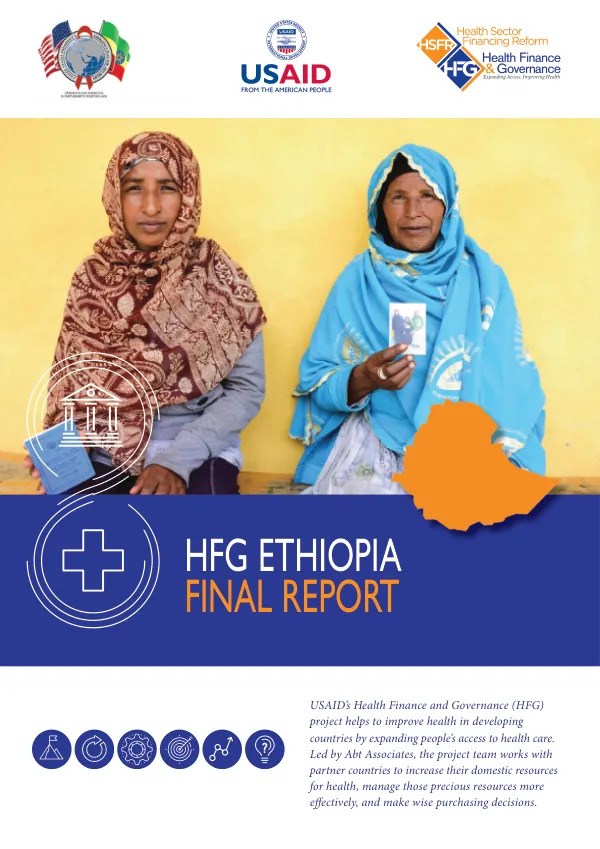
Final Report: Health Finance and Governance Project in Ethiopia
The Health Finance and Governance Project, led by Abt Associates, aims to improve health in developing countries by expanding people's access to healthcare.
2018 · 36 pages
Sign in to readA free account is required to download.
Abstract
The project team works with partner countries to increase their domestic resources for health, manage those resources more effectively, and make wise purchasing decisions. As a result, the five-year, $209 million global project will increase the use of both primary and priority health services, including HIV/AIDS, tuberculosis, malaria, and reproductive health services. The project is designed to fundamentally strengthen health systems, supporting countries as they navigate economic transitions needed to achieve universal healthcare. In Ethiopia, the project is known as the Health Sector Financing Reform/Health Finance and Governance (HSFR/HFG) project. The project's tenure is August 1, 2013, to September 29, 2018, and it received $36,645,661 in committed funding across its life. The Ethiopian health sector has made significant progress in recent years, including improving governance, increasing access to health services, strengthening health care financing mechanisms, and increasing the availability of human resources for health. However, many challenges remain, including low life expectancy, communicable diseases, and nutrition-related disorders. Health financing is also a significant challenge, with per capita health spending in 2010/11 being only $20.77 per year, about one-third of which was out-of-pocket expenditure. To address these challenges, the HSFR/HFG project implemented several key interventions, including revenue retention and utilization, facility governance, and the establishment of private wings in public hospitals. Revenue retention and utilization allows public hospitals and health centers to use the fees they collect from patients and other sources of revenue to improve the quality of services. Facility governance establishes and operationalizes governing boards in hospitals and management committees in health centers to provide overall direction and oversight of health facilities. The project also focused on strengthening health care financing mechanisms, including the establishment of a private wing in public hospitals. This allows public hospitals in most regions and at the federal level to open and operate a private wing to generate revenue from patients who are willing to pay. The project's goal is to increase the use of both primary and priority health services, including HIV/AIDS, tuberculosis, malaria, and reproductive health services. The project's performance was evaluated against expected results, and results and achievements were reported by project objective. The report closes with discussions of the challenges and lessons learned from five years of implementation, and how HSFR/HFG contributed to the sustainability of health care financing reform. The project's success was due in part to the collaboration and contributions of the Government of Ethiopia, local counterparts, and international partners, including the United States Agency for International Development (USAID), the Bill and Melinda Gates Foundation, and the World Health Organization. The project's impact on the Ethiopian health sector was significant, with improvements in health care financing, governance, and service delivery. The project's results included increased revenue retention and utilization, improved facility governance, and increased access to health services. The project also contributed to the sustainability of health care financing reform, with the Government of Ethiopia and local counterparts continuing to implement and build on the project's achievements. The project's success was also due in part to its focus on building the capacity of local counterparts and strengthening health care financing mechanisms. The project provided technical assistance and training to local counterparts, including the Federal Ministry of Health, regional health bureaus, and health facilities. The project also supported the development of policies and guidelines to support health care financing reform. Overall, the HSFR/HFG project was a significant success, contributing to the improvement of health care financing, governance, and service delivery in Ethiopia. The project's results and achievements will continue to have a lasting impact on the Ethiopian health sector, and its success serves as a model for future health care financing reform initiatives.