USAID DEC
Regional Initiative on Legal and Information Foundation E-Invoicing Activities
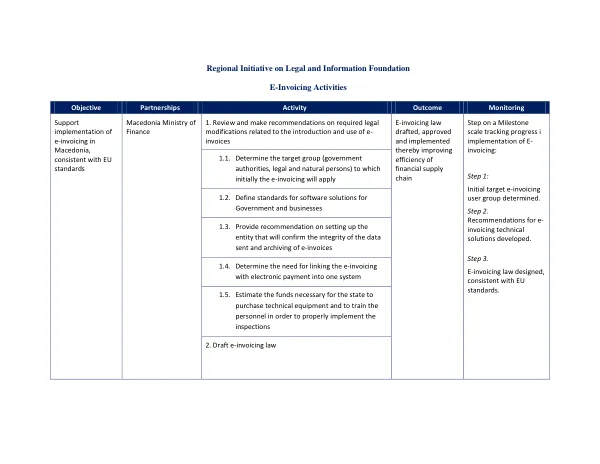
The Regional Initiative on Legal and Information Foundation E-Invoicing Activities aimed to support the implementation of e-invoicing in Macedonia, consistent with EU standards.
2013 · 2 pages
Sign in to readA free account is required to download.
Abstract
The initiative was led by the Macedonia Ministry of Finance, in partnership with the Macedonia Ministry of Information Society and Administration. The initiative's objective was to review and make recommendations on required legal modifications related to the introduction and use of e-invoices. This involved drafting and implementing an e-invoicing law that would improve the efficiency of the financial supply chain. The law was designed to be consistent with EU standards, ensuring regional harmonization. The implementation of e-invoicing in Macedonia was tracked using a milestone-based approach, with progress monitored at each step. The first step involved determining the target e-invoicing user group, which included government authorities, legal and natural persons. Recommendations for e-invoicing technical solutions were then developed, followed by the design of an e-invoicing law consistent with EU standards. The e-invoicing law was drafted to address several key areas, including the definition of standards for software solutions, the establishment of an entity to confirm the integrity of data sent and the archiving of e-invoices, and the need for linking e-invoicing with electronic payment into one system. The law also estimated the funds necessary for the state to purchase technical equipment and train personnel to properly implement the inspections. In addition to e-invoicing, the initiative also aimed to support the implementation of e-signature law in Macedonia, consistent with EU standards. The Macedonia Ministry of Finance and the Macedonia Ministry of Information Society and Administration partnered to review the existing draft e-signature law and make recommendations for amendments necessary to align the law with EU directives. The e-signature law was aligned with EU standards, and a number of amendments were suggested to the law in Macedonia to align it with EU standards and directives. The initiative also promoted the implementation of e-invoicing and e-signature laws in Macedonia, with a regional workshop organized to present draft model laws and share lessons learned with regional stakeholders. The regional workshop aimed to promote regional harmonization with EU standards and improve the implementation of e-invoicing and e-signature in PFS Beneficiary countries. The workshop was attended by a number of PFS Beneficiary countries, and regional working groups were established to further support the implementation of e-invoicing and e-signature laws.