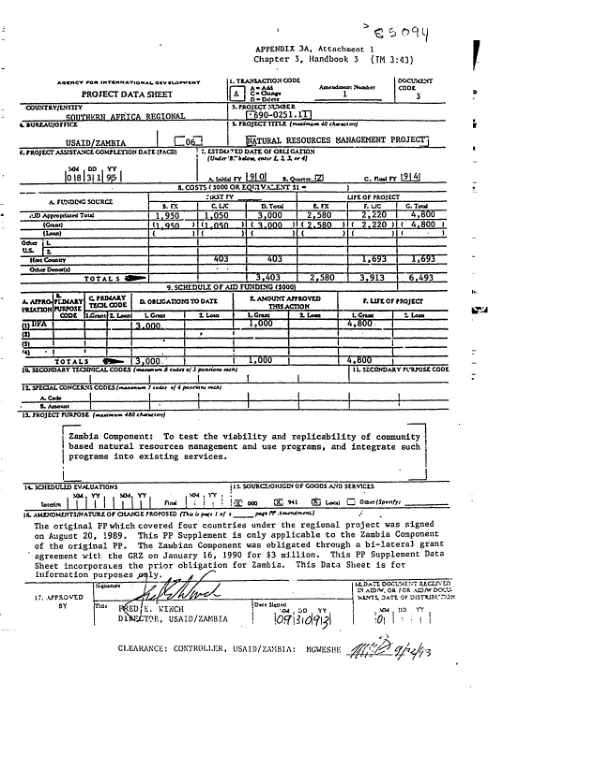
USAID. MISSION TO NAMIBIA
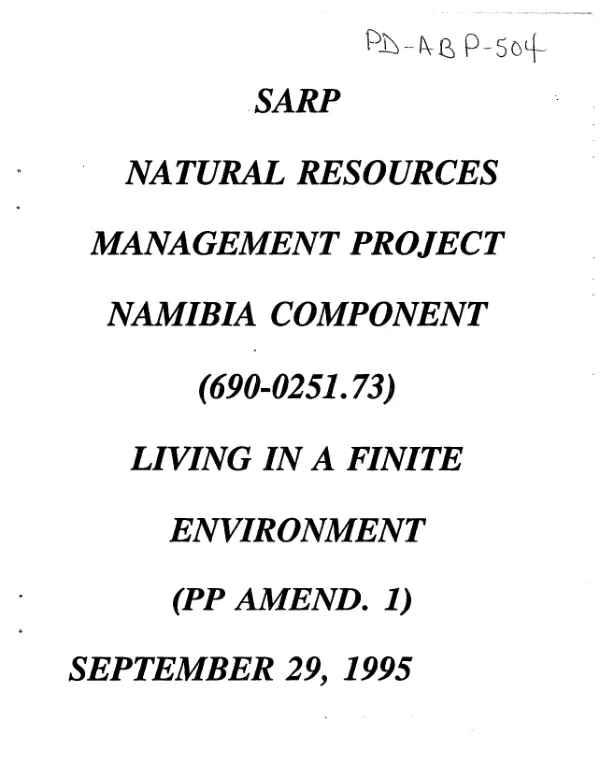
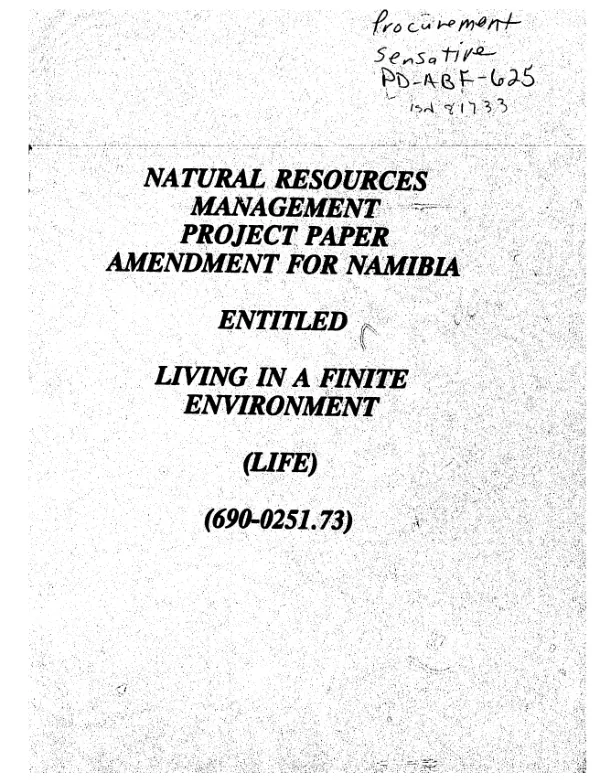
Regional natural resources management -- Namibia : amendment no. 3
Subproject (SP) to promote sustainable natural resource management (NRM) in Namibia"s rural communities in Caprivi, Bushmanland, and the Etosha Catchment area.
1992
Sign in to readA free account is required to download.
Abstract
The SP, to be implemented by the Ministry of Wildlife, Conservation, and Tourism (MWCT) and a U.S./international PVO, will have four components: community-based NRM; planning and applied research; environmental education; and regional coordination and information exchange. The SP will provide grants to local NGOs (especially the Namibia Nature Foundation) for pilot community-based NRM activities in marginal agricultural areas and the buffer zones of national parks, starting in Caprivi and Bushmanland and possibly extending to the Etosha Catchment area. Activities will be mostly adaptive or experimental and will build on ongoing or planned NGO activities. Illustrative activities include: (1) a community game warden program, placement of community liaison (extension) officers, and development of income-generating resource use schemes (e.g., tourism, hunting safaris, trophy hunting, crafts) in Damaraland/Kaokoland and East Caprivi; and (2) production of an integrated land use plan for Eastern and Western Bushmanland, to include establishment of Eastern Bushmanland as a mixed use wildlife management area, reintroduction of locally extinct species (e.g., zebra, reedbuck), conservation of biological diversity, and use of wildlife and other resources to develop income-generating schemes. Local NGO"s will provide TA, training, and material support to community-based organizations in the target areas. The project will also assist with training programs for community liaison officers, MWCT, and NGO personnel, and community groups and leaders. In-country diploma training will be open to Namibians from communities and the public and private sectors in SP target areas, while overseas degree training will be restricted to government personnel. Planning and applied research will focus on community-based NRM. Illustrative activities include: (1) studies of declining large mammal populations in Etosha, fire ecology in the Northern Kalahari woodlands, women"s use of wild plants in Caprivi, and low-impact ecotourism potential in all three target areas; (2) an ethnobotany project in Ovambo; and (3) affirmative action "People"s Botany Projects". In addition, socioeconomic topics will be integrated into the monitoring and evaluation of all SP community-based activities; such topics include tenure rights and practices, gender factors, SP impacts on leadership and decisionmaking processes, and center-periphery relationships in bureaucratic structures. This component will also strengthen MWCT"s Environmental Planning Unit through postgraduate training of a natural resource economist, and will provide training for community and NGO personnel in NRM and social science skills. Environmental education efforts will focus on supporting the MWCT"s Environmental Education Center, to be established in Etosha National Park with support from the READ project (6730004). It is expected that community leaders and liaison officers from SP target areas will benefit from the Center"s outreach program, although NGO grants may be provided to establish small community-based centers in Caprivi and Bushmanland. Finally, the SP will link the Namibian experience to programs in other project countries through regional research, conferences, workshops, and seminars. Efforts will be coordinated through the Malawi reference center. Amendment of 9/29/95 extends the PACD to 8/18/99 in order to keep pace with the PACD of the overall project, increases funding, and revises the project in accordance with the mid-term assessment. While none of the project"s essential elements are altered, the goal and purpose are restated to focus on improving the quality of life for rural populations through sustainable NRM during the project"s lifetime. The new funds will be used to increase the level of activities, expand the training component to include the Ministry of Environment and Tourism (MET), and allow enough time for the community-based activities to become sustainable. Finally, although enactment of enabling legislation for sustainable NRM -- a condition precedent for disbursement of USAID funds -- is reasonably expected, the Mission retains the right to terminate the project on 8/31/96 if the legislation is not passed. (PD-ABP-504)