USAID DEC
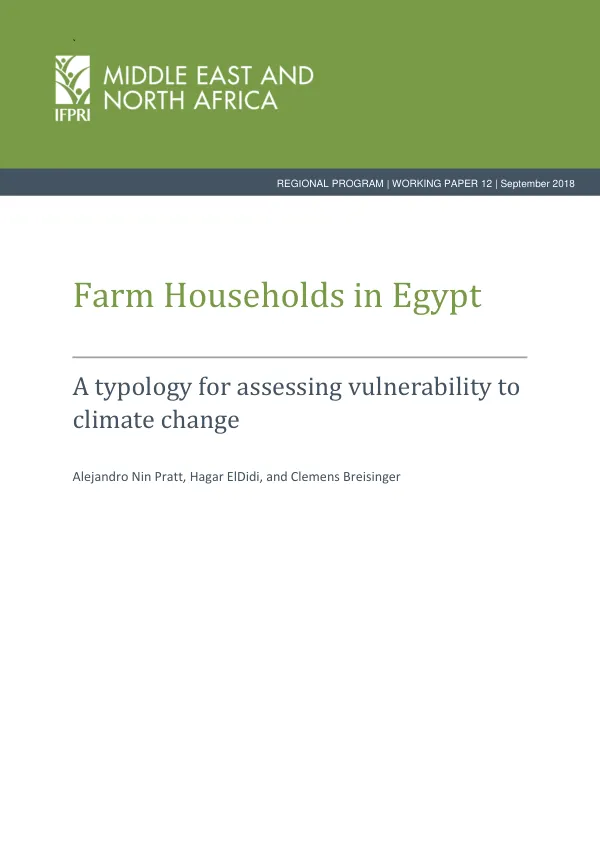
Regional Program | Working Paper 12 | September 2018: Farm Households in Egypt: A typology for assessing vulnerability to climate change
Sign inINTERNATIONAL FOOD AND POLICY RESEARCH INSTITUTE
Regional Program | Working Paper 12 | September 2018: Farm Households in Egypt: A typology for assessing vulnerability to climate change
Farm households in Egypt are vulnerable to climate change, and understanding their behavior in response to policy and environmental changes is crucial for developing effective strategies to mitigate this vulnerability.
2018 · 53 pages
Sign in to readA free account is required to download.
Abstract
A typology of farm households in Egypt has been developed using governorate-level national data and household survey data. This typology allows for the description of how different farm households behave in response to changes affecting their resources, welfare, and opportunities in output and input markets. The typology is based on a multi-step procedure that includes the use of principal components and cluster analyses to identify 14 household types. These household types are characterized by their farm size, labor, capital, and water use, as well as their income, wealth, and importance of farm income in total income. The typology also takes into account the regional differences in agricultural production and the impact of climate change on crop yields. Climate change scenarios have been projected to result in an increase in temperature of 1.6°C by 2050, leading to changes in crop yields and water demand. The study simulates the impact of these changes on farm households in different regions of Egypt, including Lower Egypt and Upper Egypt. The results show that the vulnerability of farm households to climate change varies depending on their type and location. In Lower Egypt, the most vulnerable household types are those with small farm sizes and limited access to water and labor. These households are likely to experience significant declines in crop yields and income due to climate change. In contrast, households in Upper Egypt are more resilient to climate change, but still face significant challenges due to the limited availability of water and labor. The study identifies several policy options to mitigate the vulnerability of farm households to climate change, including the development of climate-resilient agricultural practices, the improvement of irrigation systems, and the provision of support to small-scale farmers. These policy options are tailored to the specific needs of different household types and regions, and are designed to promote sustainable agricultural production and reduce the negative impacts of climate change on farm households. The study's findings and policy options are summarized in Tables 7.8 and 7.9, which provide a detailed analysis of the vulnerability of farm households in Lower Egypt and Upper Egypt, respectively. These tables highlight the importance of considering the regional differences in agricultural production and the impact of climate change on crop yields when developing policies to support farm households. Overall, the study provides a comprehensive understanding of the vulnerability of farm households in Egypt to climate change and identifies policy options to mitigate this vulnerability. The study's findings and policy options are relevant to policymakers, researchers, and practitioners working in the field of agricultural development and climate change adaptation.