USAID DEC
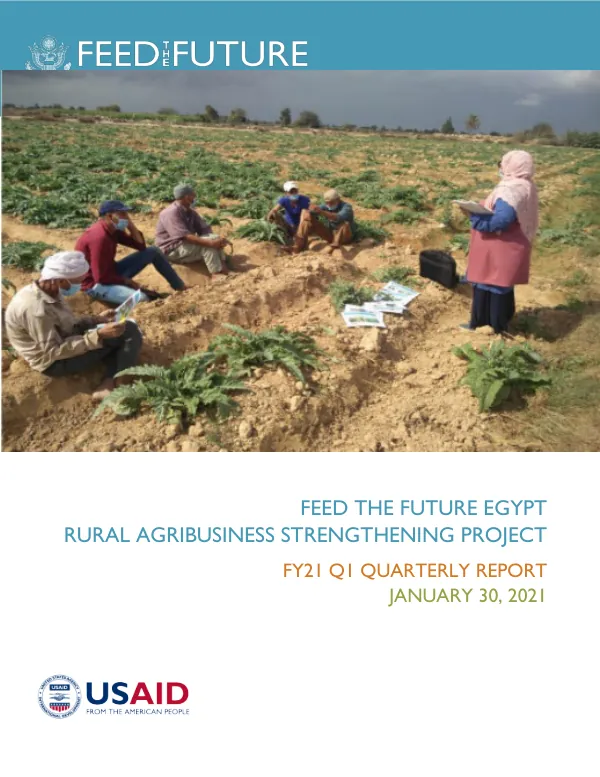
Feed the Future Egypt Rural Agribusiness Strengthening Project FY21 Q1 Quarterly Report
Sign inABT ASSOCIATES
Feed the Future Egypt Rural Agribusiness Strengthening Project FY21 Q1 Quarterly Report
The Feed the Future Egypt Rural Agribusiness Strengthening project is a five-year initiative funded by the United States Agency for International Development (USAID)/Egypt.
2021 · 42 pages
Sign in to readA free account is required to download.
Abstract
The project aims to improve the horticulture industry's ability to respond to domestic and international buyer demand and strengthen the industry's competitiveness by applying a market-driven, systems-strengthening approach. The project is implemented by Abt Associates with subcontractors CID Consulting, J.E. Austin Associates, 20/20 Development Company, and the Global Cold Chain Alliance. The project is strengthening Egypt's horticulture market system and improving the capacity of smallholder farmers and processors, producer organizations (POs), and horticultural institutions through agricultural knowledge transfer and training. Improvements to the target value chains are raising employment and incomes for vulnerable Egyptians and enhancing food security throughout the country. The project's goal is to create a more competitive and inclusive Egyptian economy through horticulture sector growth, with special focus on securing employment and increasing agriculture-related incomes of smallholder farmers in Upper Egypt and the Delta. The project contributes directly to USAID/Egypt's Development Objective of "a more competitive and inclusive Egyptian economy through growth in selected sectors," and to the sub-objective of "increased agriculture-related incomes of smallholder farmers." The project will achieve this goal through integrated activities across four areas: Strengthening domestic and international linkages, improving post-harvest handling and storage, increasing productivity of smallholder farmers and food processors, and improving the nutritional status of women and children. In response to the COVID-19 global outbreak, the project closed its four offices and had staff work from home in March 2020. The project team rapidly and successfully adjusted activities and implementation approaches to continue its engagement with agribusinesses, smallholder farmers, packhouses, and other key actors virtually, using online platforms. In September, the project restarted select in-person meetings and technical assistance while requiring adherence to strict safety guidelines and protocols established by the Government of Egypt and Ministry of Health. In FY21 Q1, the project achieved numerous milestones, including the creation of 46 full-time equivalent jobs. Producer organizations who were fulfilling project-facilitated supply contracts hired laborers to help with packing and shipping, contributing 7.5 full-time jobs. Through project-facilitated process, six financial institutions (FIs) disbursed 296 agri-loans with a total value of 5,922,000 Egyptian Pounds (EGP) ($377,659). Of these loans, 63 (21%) with a total value of 1,243,620 EGP went to female farmers. The project is currently implementing its activities in 14 governorates, including Alexandria, Assiut, Aswan, Beheira, Beni Suef, Cairo, Dakahlia, Giza, Gharbia, Ismailia, Luxor, Menoufia, Minya, Qalyoubia, Qena, Sharkia, and Sohag. The project's geographic coverage is extensive, with a focus on Upper Egypt and the Delta regions. The project's Results Framework diagram outlines its four intermediate results (IRs): Strengthened sustainable domestic and international market linkages, improved post-harvest handling and storage, increased productivity for small farmers and food processors, and improved nutritional status of women and children. The project's implementation is ongoing, with a focus on achieving its IRs and contributing to the development of a more competitive and inclusive Egyptian economy.