USAID. MISSION TO ZIMBABWE
Regional transport development (Mozambique railways)
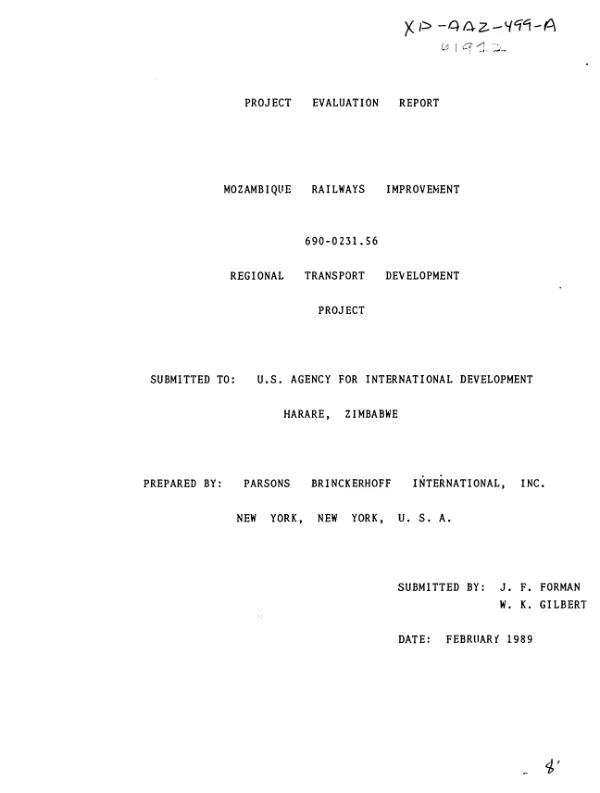
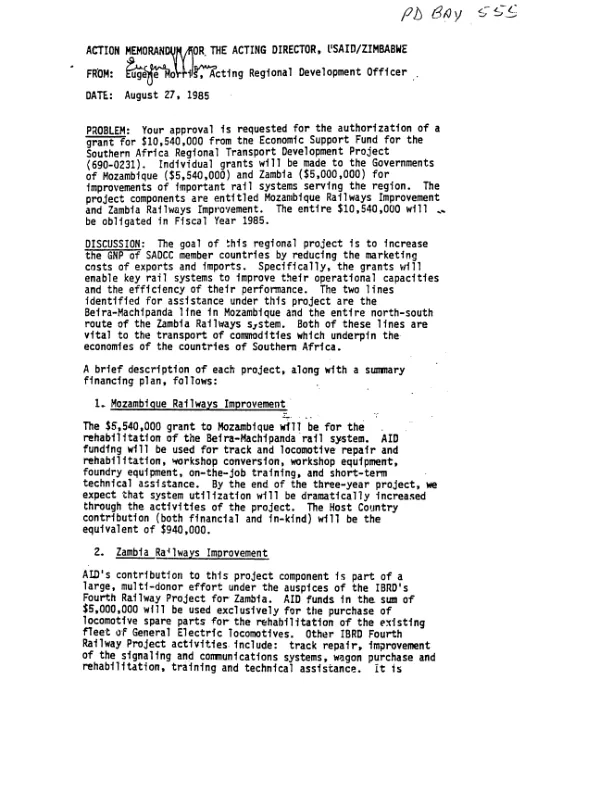
Summarizes final evaluation (XD-AAZ-499-A) of a project to rehabilitate Mozambique"s Beira-Machipanda railroad system, the most direct link to the Indian Ocean for northern Zimbabwe and sections of Malawi, Zambia, and southern Zaire.
1989
Sign in to readA free account is required to download.
Abstract
Evaluation covered the period 1985-6/89. Despite some delays, the project was generally a success. The delivery of locomotives remanufactured by the project - 9 steam and 2 diesel electric - as well as commodities for the Beira workshop and foundry was delayed up to one and one-half years. Procurement of track equipment and tools was also late, but emergency track repair of 141 km was completed with assistance from National Railways of Zimbabwe. First phase conversion of the Beira steam workshop to diesel electric locomotive maintenance was completed within budget and on time. Effective training and TA provided at the Beira workshop resulted in the rehabilitation of 2 steam locomotives. Mozambique Railways Central (CFM(C)) technicians received 34 months of training as planned, but the training was not as successful as anticipated due to poor planning and lack of qualified Portuguese-speaking trainers. The overall effectiveness of the project is seen in the increase in total cargo movement (from 280,000 net tons in 1985 to 486,000 tons in 1988) and the number of trains per day (from 2.4 in 1985 to 3.6 in 1988). Improvements in the railway system have also been supported by simultaneous efforts to revamp the related Beira port system. Several lessons were learned. (1) Poor procurement planning leads almost invariably to poor implementation. (2) Clearance by a commodity management officer should be required on any services contract which contains a large commodity procurement element. (3) Procurement responsibility should not be assigned to contractors who are probably incapable of complying with A.I.D. regulatory requirements. (4) Follow-up training is required to ensure the maintenance of national railways locomotive fleets. (5) A liquidated damages clause should be incorporated into a contract when the extent of damages and loss resulting from contractor nonperformance can be determined at the time of award.
Related documents