USAID. BUR. FOR AFRICA. REGIONAL ECONOMIC DEVELOPMENT SERVICES OFC. (REDSO) EAST AFRICA
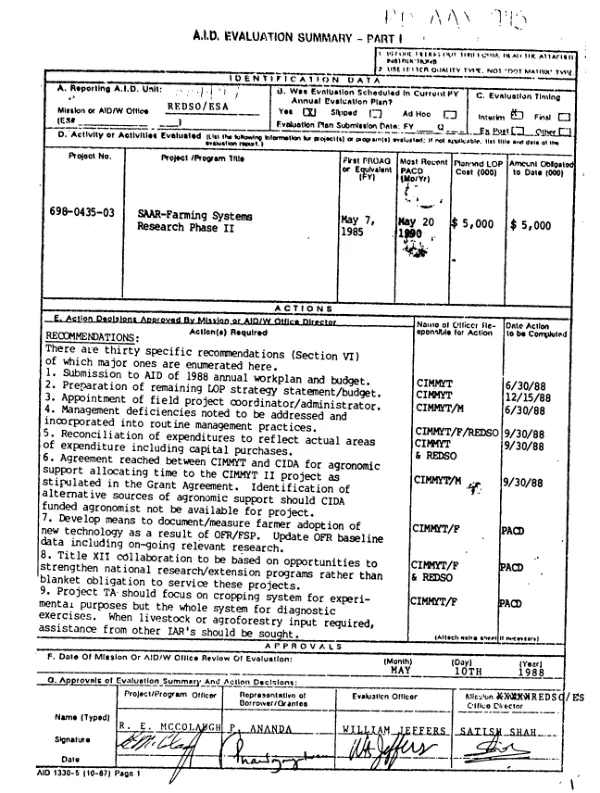
SAAR - farming systems research phase II
Summarizes attached evaluation of project, implemented by the International Maize and Wheat Improvement Center (CIMMYT), to support on-farm research with a farming systems perspective (OFR/FSP) in participating countries in Eastern and Southern Africa.
Stroud, Ann; Trip, Robert +1 more · 1988
Sign in to readA free account is required to download.
Abstract
Mid-term evaluation covers the period 5/85-5/88, and is based on visits to four countries, interviews with farmers, trainees, and others, and document review. The project is making significant contributions to strengthening OFR/FSP methodology at regional and national levels within research, extension, and university systems. The impact of this new methodology, which places the farmer in a key role within an interdisciplinary OFR team, can be seen throughout the research/extension continuum. In some countries, this is the first time the farmer has been taken into account as a rational user of his/her natural resources and as the best person to explain why they are used the way they are. Project training activities have received very positive responses, with particluar praise going to regional workshops, where the majority of OFR practitioners in the region received their initial training. Another key output has been fostering the institutionalization of OFR within university systems and creating research-university linkages. Strong OFR/FSP programs have been developed in universities in Tanzania and Zambia, and two postgraduate OFR studentships are supported in Zimbabwe. Extension needs to be better integrated into the project"s operational mode, however, and the OFR approach needs to be modified to include agroforestry and livestock. Other problems center around the need to improve data and information management systems. CIMMYT should draw up a detailed plan for the remainder of the project, and reassess workplans, future resource allocations, staff coordination, and other factors as a first step toward adjusting project activities. The project teaches three lessons. (1) TA support was to be provided by another donor, but differences in project agreements and scopes of work prevented its successful integration into the project. Better donor coordination is needed. (2) Projects which have personnel and activities scattered throughout several countries should have detailed annual workplans and implementation strategies to avoid miscommunication and misunderstandings. REDSO/ESA staff should conduct more site visits to better know field activities. (3) Weak linkages with bilateral programs involving Title XII institutions have hampered performance; REDSO/ESA should work more closely to strengthen these institutions" ties with the project. Over 30 recommendations address these issues. REDSO/ESA and CIMMYT comments are included.