USAID DEC
RELATIONSHIPS AND GENDER-BASED VIOLENCE IN TIMOR-LESTE BASELINE STUDY FOR THE HEALTHY RELATIONSHIPS FOR A VIOLENCE-FREE FUTURE ACTIVITY
Sign inWORLD VISION
RELATIONSHIPS AND GENDER-BASED VIOLENCE IN TIMOR-LESTE BASELINE STUDY FOR THE HEALTHY RELATIONSHIPS FOR A VIOLENCE-FREE FUTURE ACTIVITY
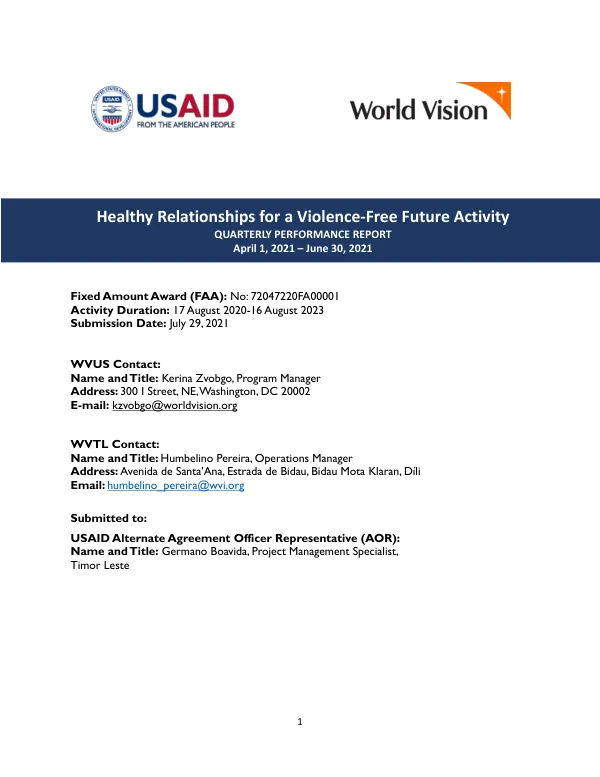
The Healthy Relationships for a Violence-Free Future Activity is a USAID-funded five-year program implemented by World Vision Timor-Leste.
2021 · 70 pages
Sign in to readA free account is required to download.
Abstract
The program aims to promote healthy, non-violent relationships among individuals, families, and communities, with a focus on ending gender-based violence (GBV). The program targets 5,000 people in 16 sucos (villages) in three districts in Timor-Leste. The program's overarching goal is to achieve "safe and non-discriminatory relationships" among individuals, families, and communities. To achieve this goal, the program focuses on promoting healthy, non-violent relationships, particularly between intimate partners, between adolescents and their caregivers, and among adolescents themselves. The program also aims to change behaviors and attitudes and the underlying gender norms and inequitable social structures that drive GBV. The program's approach is based on a "people-to-people" approach, which involves working with local communities to identify and address the root causes of GBV. The program also focuses on building the capacity of local organizations and community-based organizations to address GBV. The program's target population includes adolescents, caregivers, and caregivers' partners. The program also targets community leaders and duty bearers, such as local government officials and law enforcement officers. The program's activities include: * Promoting healthy, non-violent relationships among individuals, families, and communities * Changing behaviors and attitudes and the underlying gender norms and inequitable social structures that drive GBV * Building the capacity of local organizations and community-based organizations to address GBV * Providing support to survivors of GBV and their families * Advocating for policies and laws that address GBV The program's indicators include: * The proportion of adolescents who have experienced violence in the past 12 months * The proportion of caregivers who have experienced physical or emotional abuse * The proportion of caregivers who have experienced economic or social abuse * The proportion of caregivers who have experienced sexual abuse * The proportion of adolescents who have experienced sexual abuse * The proportion of caregivers who have experienced GBV * The proportion of adolescents who have experienced GBV The program's baseline study was conducted in June 2021, and the results showed that: * 27% of adolescents reported experiencing violence in the past 12 months * 38% of caregivers reported experiencing violence in the past 12 months * 45% of caregivers reported experiencing physical or emotional abuse * 35% of adolescents reported experiencing physical or emotional abuse * 25% of caregivers reported experiencing economic or social abuse * 20% of adolescents reported experiencing economic or social abuse * 15% of caregivers reported experiencing sexual abuse * 10% of adolescents reported experiencing sexual abuse * 30% of caregivers reported experiencing GBV * 25% of adolescents reported experiencing GBV The program's recommendations include: * Increasing the proportion of adolescents who have experienced physical or emotional abuse * Increasing the proportion of adolescents who have experienced economic or social abuse * Increasing the proportion of caregivers who have experienced GBV * Increasing the proportion of adolescents who have experienced GBV The program's conclusions include: * The baseline study showed that GBV is a significant problem in Timor-Leste, with 27% of adolescents and 38% of caregivers reporting experiencing violence in the past 12 months. * The program's approach is based on a "people-to-people" approach, which involves working with local communities to identify and address the root causes of GBV. * The program's activities include promoting healthy, non-violent relationships among individuals, families, and communities, changing behaviors and attitudes and the underlying gender norms and inequitable social structures that drive GBV, building the capacity of local organizations and community-based organizations to address GBV, providing support to survivors of GBV and their families, and advocating for policies and laws that address GBV.