USAID DEC
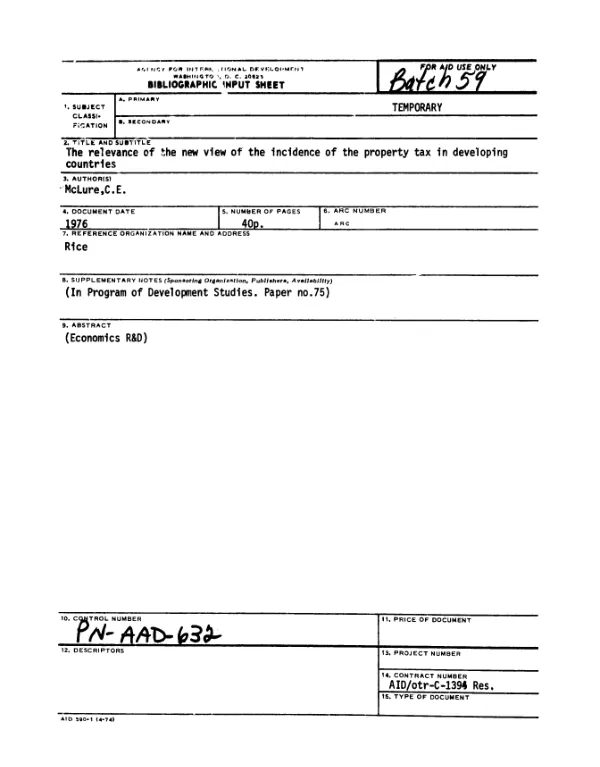
Relevance of the new view of the incidence of the property tax in developing countries
Sign inRICE UNIVERSITY
Relevance of the new view of the incidence of the property tax in developing countries
Examines the relevance of a new view of the incidence of the property tax in developing countries.
McLure, C. E. · 1970
Sign in to readA free account is required to download.
Abstract
The incidence depends upon what question is being asked and what the conditions are in the country under examination, especially for the international mobility of capital. Other determinants of incidence, such as the geographic scope of the tax, sectoral differentials, consumption patterns, imperfect competition, and rent controls, are discussed. The fundamental difference between the two views lies in the assumptions about the elasticity of supply of capital. The old view assumes capital to be an infinitely elastic supply and concludes that the part of the property tax levied on improvements cannot be borne by owners of capital. This tax is thought to be shifted forward to consumers and to be regressive. The new view takes the supply of capital to be totally inelastic. As a result, the property tax on improvements is borne by owners of capital rather than being shifted forward. Given the distribution of ownership of capital by income classes, the property tax is progressive, rather than regressive. Section 3 presents the application of the new view to the incidence problem in developing countries. This section describes the basic assumptions under which the analysis proceeds, especially those of perfect competition and neglect of benefits. It notes the need to specify exactly the incidence question at issue and examines the crucial role played by assumptions of mobility. It applies the theoretical lessons of the previous discussion, along with the broad characteristics of taxation and other economic patterns found in developing countries, and it suggests general tendencies in the incidence of taxation among income classes and implications for the conduct of incidence studies.
Related documents
Documents in this collection
 1984
1984USAID DEC
Location - allocation algorithms as a method of locating facilities in developing countries : extensions to cope with identified policy constraints
Open record 1970
1970USAID DEC