USAID. MISSION TO SENEGAL
Renewable energy
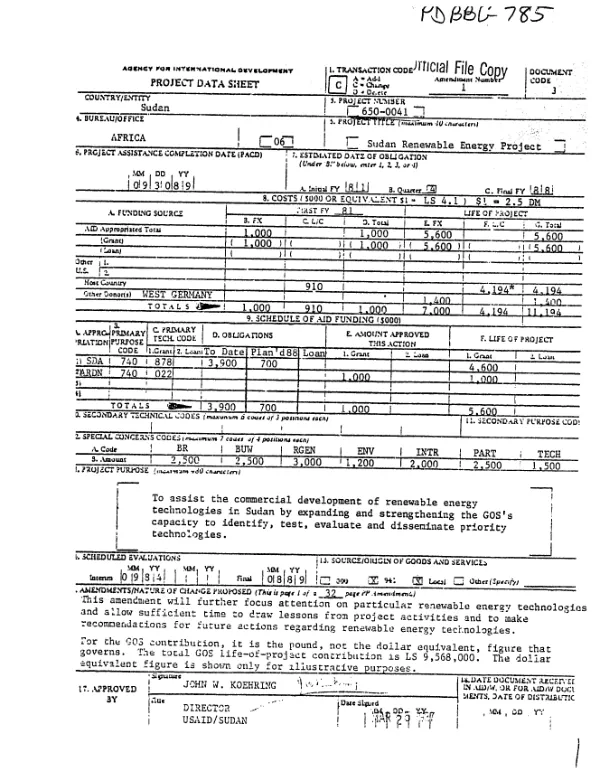
Project to promote the use of renewable energy resources in Senegal by upgrading charcoal production and by designing and testing both more efficient woodburning cookstoves and solar tent fish drying and storage systems.
1979
Sign in to readA free account is required to download.
Abstract
The State Secretariat for Scientific and Technical Research (SERST) will coordinate project implementation. To improve charcoal production, the State Secretariat for Water and Forests will form traveling training teams, composed of six trainers to be trained in a similar FAO project, to conduct 6-week training and demonstration in the new Casamance kiln method for 270 heads of cooperative charcoal-making teams. At each training session, two Casamance kilns will be built and burned. Trainees will receive living subsidies, a share in the charcoal sale proceeds, and a chimney - to be built by local blacksmiths - to take back to his cooperative so as to hasten adoption of the new method. The training director will make follow-up field visits. Expatriate TA will help the University of Dakar"s Institut de Physique Meteorologique (IPM) design prototypes of more efficient woodburning cookstoves (probably to be based on the Lorena stove made of clay and sand) and will provide representatives from Maison Familiale Rurale (MFR), a grass-roots development organization, with a 6-day training program aimed at teaching men how to build stoves and women how to cook on them. MFR teams will then build the new stoves at local MFR centers and demonstrate their use to villagers. PCV"s will collect data on use of the new stoves which IPM will use to refine the models. An ad hoc committee headed by the SERST will determine whether more widespread testing and dissemination is feasible. Development of solar tent fish drying and storage systems will proceed in two stages. First, the Institut de Technologie Alimentaire (ITA) will develop, both at its Dakar facility and in field sites at Joal and Mbour, small- and large-scale model systems out of materials such as heavier polyethylene, plexiglass, framing, and drying rack materials. If this phase is successful, ITA will install 10-15 new systems in four villages, train villagers in their use, and monitor system performance.
Related documents