TETRA TECH ESI, INC.
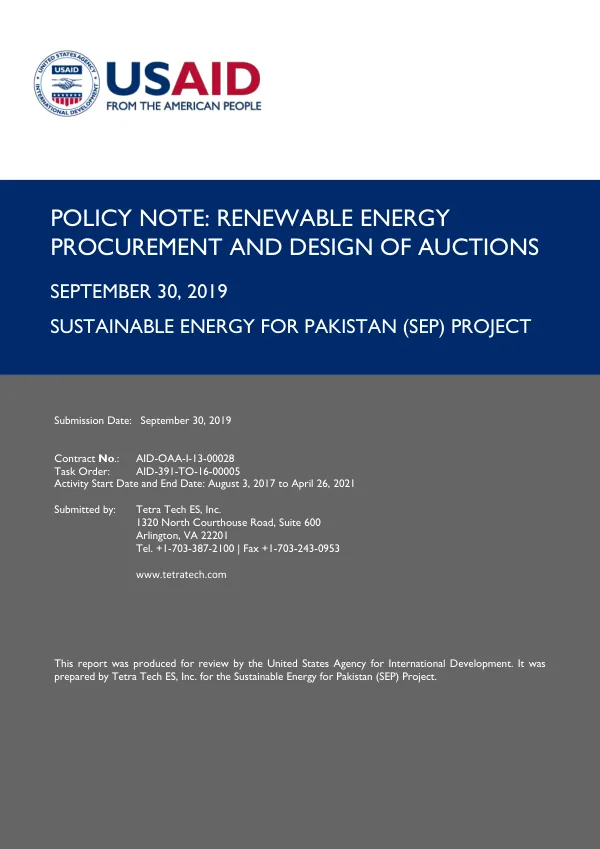
Renewable Energy Procurement and Design of Auctions
The Government of Pakistan has committed to increasing the share of renewable energy (RE) in the overall generation-mix from approximately 4% to about 25% by 2025, and to 30% by 2030.
2019 · 47 pages
Sign in to readA free account is required to download.
Abstract
To achieve this goal, a new "Alternative and Renewable Energy (ARE)" policy is expected to be announced, which will set out an overall framework for the development of indigenous energy resources, particularly solar, wind, and bagasse-based power projects. International experience suggests that certain conditions must be met and parameters adopted for the development of large-scale RE deployment in any country. These conditions include the creation of appropriate enabling conditions to mobilize private investments in RE development. Increasing the share of RE projects in the overall generation-mix presents several issues that need to be addressed, including the physical and operational characteristics of RE, such as variability, intermittency, and dispersed locations. Globally, a variety of policy options have been deployed to promote renewables. While different countries have their own unique features, such as their power systems, geography, and economies, their experience can be a useful guide in developing RE policies and applying them at operational levels. RE policies may vary from country to country to reflect their respective renewable resource potentials, current state of deployment, regulatory frameworks, political priorities, and fiscal constraints. Auctions have been shown to be an important mechanism for promoting the deployment of RE. As a market mechanism, auctions enable governments to contract a pre-defined volume of energy at a competitive cost. When well-designed, the price competition inherent to the auction scheme increases cost efficiency and allows price discovery of RE-based electricity, avoiding potential windfall profits and underpayments. There are three main types of auction formats: the sealed-bid auction, the descending clock auction, and the hybrid auction. The design features of auctions, including the auction's demand, qualification requirements, winner selection, and investor risks and liabilities, strongly influence the price outcomes. Policy makers should carefully consider these auction design elements to balance the trade-offs between specific auction design elements and the electricity market design, as well as the context in which the auctions take place. The design of auctions should take into account the physical and operational characteristics of RE, such as variability and intermittency. Auctions could be multi-stage and could be technology-specific or technology-neutral. However, it is difficult to design an auction that is neutral to all technologies. Successful auctions that meet the goals of both policymakers and society balance the trade-offs between specific auction design elements and the electricity market design, as well as the context in which the auctions take place. In Pakistan, the creation of an enabling environment for RE development is necessary to mobilize private investments. This includes the development of a clear policy framework, regulatory frameworks, and a supportive institutional structure. The design of auctions should be carefully considered to balance the trade-offs between specific auction design elements and the electricity market design, as well as the context in which the auctions take place. The Government of Pakistan should consider the following key lessons from global experience when designing auctions for RE procurement: * Auctions should be well-designed to increase cost efficiency and allow price discovery of RE-based electricity. * Auctions could be multi-stage and could be technology-specific or technology-neutral. * The design features of auctions, including the auction's demand, qualification requirements, winner selection, and investor risks and liabilities, strongly influence the price outcomes. * Policy makers should carefully consider these auction design elements to balance the trade-offs between specific auction design elements and the electricity market design, as well as the context in which the auctions take place. By considering these key lessons from global experience, the Government of Pakistan can design effective auctions for RE procurement that promote the development of large-scale RE deployment in the country.