TETRA TECH ESI, INC.
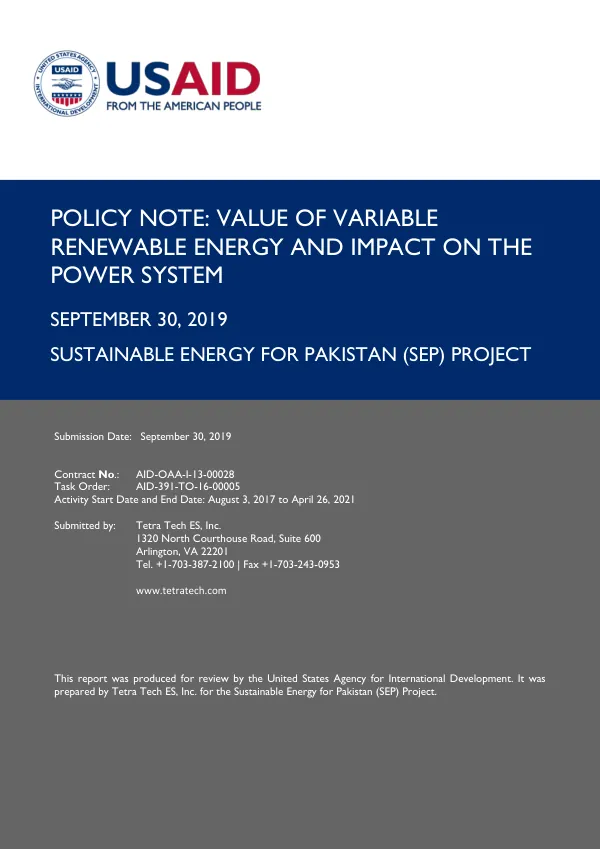
Value of Variable Renewable Energy and Impact on the Power System
The Government of Pakistan has committed to increasing the share of renewable energy (RE) in the overall generation-mix from approximately 4% to about 25% by 2025 and to 30% by 2030.
2019 · 31 pages
Sign in to readA free account is required to download.
Abstract
A new "Alternative and Renewable Energy (ARE)" policy is expected to be announced, which will amplify this emphasis and set out an overall framework for the development of indigenous energy resources, particularly solar, wind, and bagasse-based power projects. Increasing the share of RE projects in the overall generation-mix presents several issues that need to be addressed, including the physical and operational characteristics of RE such as variability, intermittency, dispersed locations, and so forth. Globally, a variety of policy options have been deployed to promote renewables, and while different countries may have their own unique features, their experience can be a useful guide in developing RE policies and applying them at operational levels. Power systems around the world are undergoing significant change, driven particularly by the increasing availability of low-cost variable renewable energy (VRE), the deployment of distributed energy resources (DER), advances in digitalization, and growing opportunities for electrification. As power systems transform and more VRE projects come online, power system flexibility has become a global priority. Electricity generating power plants interact with each other and their customers through the electricity grid and with the wider natural, economic, and social environment. VRE technologies are different from conventional technologies, with generation from VRE resources typically being variable, non-synchronous, location-specific, modular, and having negligible or zero fuel costs. These attributes present several challenges and opportunities for increasing VRE in the overall system and ensuring that the power system remains stable and resilient. System effects, such as intermittency, network congestion, and instability, can affect the quality of the natural environment or pose risks in terms of security of supply. Costs implications at the grid level include additional investments to extend and reinforce transmission and distribution grids and to connect new capacity on the grid, as well as increased short-term balancing and maintaining the long-term adequacy of electricity supply in the face of the intermittency of variable renewables. International experience suggests that VRE is already impacting the bulk power market, with modest impacts on average wholesale prices and limited impacts on power plant retirements. However, VRE impacts on the bulk power market will grow with penetration, and the "system value" of VRE will decline with penetration. Power system flexibility can reduce the rate of VRE value decline. The main challenges for policymakers in addressing VRE integration are ensuring VRE is deployed in a way that makes the most of VRE generation, managing the impacts of VRE on the power system, and addressing the costs implications at the grid level. To address these challenges, policymakers can draw on international experience and apply a range of policy options, including those related to bankability, system flexibility, and RE targets. In Pakistan, the National Electric Power Regulatory Authority (NEPRA) has been working to develop a framework for the integration of VRE into the power system. The framework includes measures to ensure the stability and reliability of the grid, as well as to address the costs implications of VRE integration. The framework also includes provisions for the development of new transmission and distribution infrastructure to support the integration of VRE. The development of VRE in Pakistan is expected to have several benefits, including reducing greenhouse gas emissions, improving air quality, and enhancing energy security. However, the integration of VRE into the power system also presents several challenges, including managing the impacts of VRE on the power system and addressing the costs implications at the grid level. To address these challenges, policymakers in Pakistan can draw on international experience and apply a range of policy options, including those related to bankability, system flexibility, and RE targets. The development of a comprehensive framework for the integration of VRE into the power system will be critical to ensuring the stability and reliability of the grid and addressing the costs implications of VRE integration. The Government of Pakistan has committed to increasing the share of renewable energy (RE) in the overall generation-mix from approximately 4% to about 25% by 2025 and to 30% by 2030. To achieve this goal, the government will need to develop a comprehensive framework for the integration of VRE into the power system, including measures to ensure the stability and reliability of the grid and to address the costs implications of VRE integration.