USAID DEC
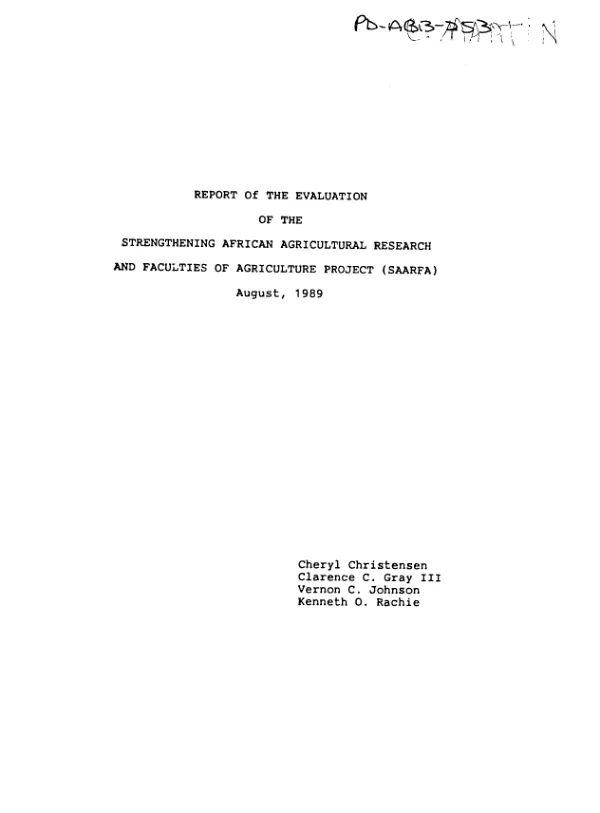
Report of the evaluation of the strengthening African agricultural research and faculties of agriculture project (SAARFA)
Sign inUSAID. BUR. FOR AFRICA. OFC. OF REGIONAL AFFAIRS
Report of the evaluation of the strengthening African agricultural research and faculties of agriculture project (SAARFA)
Interim evaluation of a project to improve national agricultural research systems (NARS) in five ecological zones in sub-Saharan Africa and to encourage coordination among donors participating in this effort.
Christensen, Cheryl; Gray, Clarence C., III (1917-2017) +2 more · 1989
Sign in to readA free account is required to download.
Abstract
The evaluation covers the period 1982-8/89. The project is fulfilling its purpose: 13 subprojects are operational, research networks have been established, socioeconomic research is complementing technical research, and a donor group under the World Bank -- Special Programs for African Agricultural Research (SPAAR) -- is cooperating enthusiastically. Several research findings have important policy implications, e.g., that the search for off-farm employment is increasing and that cultivation is being pushed more and more onto marginal and sub-marginal lands, resulting in a transition in production and consumption from foodgrains to "poor man"s crops" (i.e., roots, tubers, and legumes). A key recommendation is that commodity research networks focus on the basics of crop, soil, and water use as well as on crop-specific improvements, and shift their emphasis to cropping practices sustainable on small, low-input farms. The project"s most complicated problems are integrating its many facets, maintaining management efficiency, maintaining control over subproject grants, and welding this umbrella project into a sustainable package. Management problems are mainly administrative details related to cooperative agreements and slow vouchering and reporting due primarily to external conditions. The delegation of management functions to the field has gone smoothly. Although project networks have been effective, interactions between these networks and bilateral programs and between socioeconomic and commodity research need strengthening. While SPAAR is rated highly among donor members, African research directors in Kenya and other countries have only a hazy idea of the group and its activities. Several lessons were learned. (1) Substantial benefits can accrue to donors and NARS through donor coordination. (2) Commodity research networks are cost-effective investments that leverage resources of donors and participating interantional agricultural research centers and NARS. (3) Micro and macro socioeconomic research is necessary to understand the development impact and consequences of agricultural research and provide related policy guidance. (4) A large umbrella project with diverse purposes and activities can be effectively administered and managed if responsibilities for field activities are decentralized and clearly defined and delineated.
Related documents
Documents in this collection
 1989
1989USAID DEC
Report of the evaluation of the strengthening African agricultural research and faculties of agriculture project (SAARFA)
Open record 1984
1984USAID DEC