USAID DEC
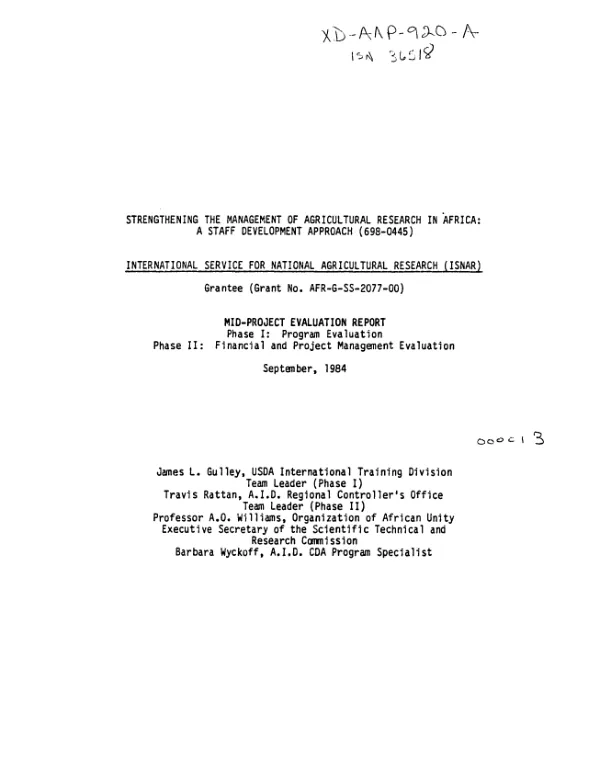
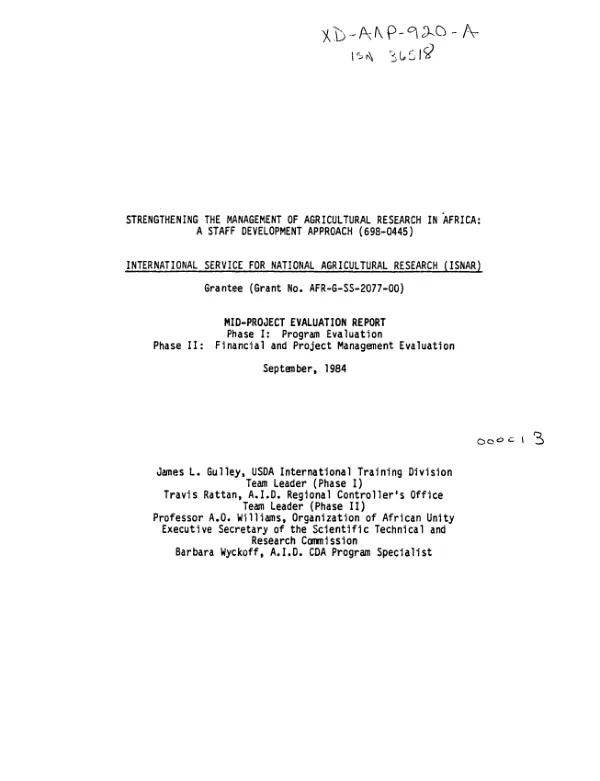
Strengthening the management of agricultural research in Africa : a staff development approach (698-0445); mid-project evaluation report, phase I : program evaluation, phase II : financial and project management evaluation
Sign inUSAID. BUR. FOR AFRICA. OFC. OF REGIONAL AFFAIRS
Strengthening the management of agricultural research in Africa : a staff development approach (698-0445); mid-project evaluation report, phase I : program evaluation, phase II : financial and project management evaluation
Evaluates project implemented by the International Service for National Agricultural Research (ISNAR) to strengthen the management of African agricultural research.
Gulley, James L.|Rattan, Travis · 1984
Sign in to readA free account is required to download.
Abstract
Special evaluation covers the period 9/82-8/84 and is based on document review, site visits, and interviews with ISNAR staff. The project, with some modifications, is well on schedule. ISNAR has completed country studies in Zimbabwe, Sudan, and Cameroon to determine specific research management needs; developed 8 case studies (most rated as average, some as excellent) on management issues (vs. the targeted 10; 3-4 more and accompanying teaching notes for all case studies are planned); and, using lectures, group discussions, and the case studies, conducted well-received management workshops for African research directors and scientists at the International Institute of Tropical Agriculture in Nigeria for 1 week (a trial workshop held in 1982), at the Eastern and Southern African Management Institute in Tanzania (7/83) for 26 participants (2 weeks), and at the Mananga Agricultural Management Center in Swaziland (7/84) for 18 participants (4 weeks). Additional workshops are planned for Cameroon (9/84), Mali (2/85), and possibly Kenya. However, due to difficulties on the part of both ISNAR and A.I.D. there has been a serious cash flow problem throughout the project; e.g., ISNAR did not receive initial project funding until 6/83 due to delays in satisfying the condition precedent that it have a properly accountable financial system. Also, although ISNAR's project modifications (i.e., reducing the country studies from the planned 4-5 to 3; reducing the number and increasing the length of workshops) are appropriate, A.I.D. was not properly consulted about nor notified of the changes. Finally, ISNAR has not prepared its planned work agenda; has failed to submit a quarterly report for April-June 1983; and contracted 2 workshop consultants at an excessive cost. Recommendations include to continue the project and consider an extension pending the outcome of a final impact evaluation; also, ISNAR should submit a letter to A.I.D. justifying the project changes and increase its collaboration with African institutions.
Related documents
Documents in this collection
 1984
1984USAID DEC
Strengthening the management of agricultural research in Africa : a staff development approach (698-0445); mid-project evaluation report, phase I : program evaluation, phase II : financial and project management evaluation
Open record 1989
1989USAID DEC