MANAGEMENT SCIENCES FOR HEALTH
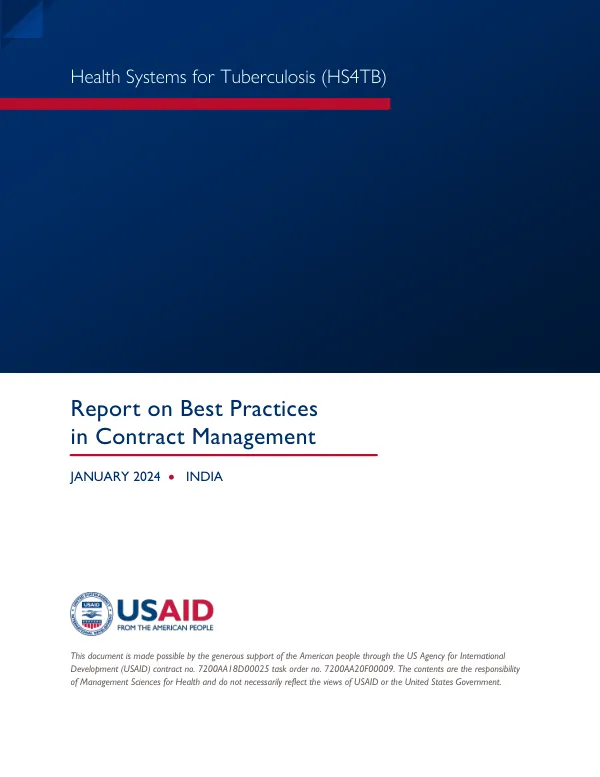
Report on Best Practices in Contract Management for HS4TB India
The Health Systems for Tuberculosis (HS4TB) project in India aims to transform the way country leaders and health system managers understand and work toward TB control and elimination.
2024 · 51 pages
Sign in to readA free account is required to download.
Abstract
The project is a five-year USAID contract focusing on health systems priorities that most directly support achievement of TB outcomes, with a focus on health financing and governance in the USAID TB priority countries. The project helps countries increase domestic financing, use key TB resources more efficiently, build in-country technical and managerial competence and leadership, and support policy formation and dissemination. The HS4TB project is led by Management Sciences for Health (MSH) in partnership with Nathan Associates and Open Development. The project's goal is to support the Government of India (GOI) in strengthening its health systems to effectively manage TB services. The project focuses on five key areas: health financing, governance, human resources, information systems, and service delivery. In 2019, the GOI launched Technical Support Units (TSUs) in nine states to provide technical support to State TB Cells. The TSUs were tasked with providing expert advice on strategic purchasing and private-sector engagement, as well as facilitating direct benefits transfers (DBT) to patients. In 2022, the HS4TB project set up more specialized technical support units called Partnership and Innovation Units (PIUs) in five other states: Andhra Pradesh, Telangana, Gujarat, Odisha, and Delhi. The PIUs aim to support and build the capacity of the State TB Cells, specifically in contracting with the private sector. The report on best practices in contract management for TB services in India highlights the importance of effective contract management in achieving TB control and elimination. The report documents best practices in contract management, drawing from global literature, GOI documents, and the HS4TB team's expertise. The report uses a problem matrix approach to diagnose problems and propose solutions based on early lessons drawn from the contracting process carried out in the five HS4TB-supported states. The report focuses on the contract management process, beginning with the "pre-contract" or pre-procurement phase, which entails the initial scoping and definition of services to contract; through the "contracting" phase, which ends with the contract signing between the government and service provider; and then the post-contracting phase. The report proposes solutions addressing challenges occurring across these three phases, including invoicing and verification processes. The report provides a summary of context-specific recommendations and guidance arising from the HS4TB experiences that may be relevant for both the PIU- and TSU-supported states to optimize the contracting process and ensure effective contract implementation in key process areas. The report serves as an evidence-based reference point for the project to engage the GOI and partners such as USAID in streamlining and refining its technical support and programming needs for TB contracting in future. The report highlights the importance of effective contract management in achieving TB control and elimination. It emphasizes the need for a robust contract management system that ensures timely and efficient payment to service providers, as well as effective monitoring and evaluation of contract implementation. The report provides a framework for contract management that can be adapted to the specific needs of different states and contexts. Overall, the report provides a comprehensive overview of the contract management process for TB services in India and highlights the importance of effective contract management in achieving TB control and elimination. It provides a framework for contract management that can be adapted to the specific needs of different states and contexts, and serves as an evidence-based reference point for the project to engage the GOI and partners such as USAID in streamlining and refining its technical support and programming needs for TB contracting in future.
Related documents