ENGENDERHEALTH
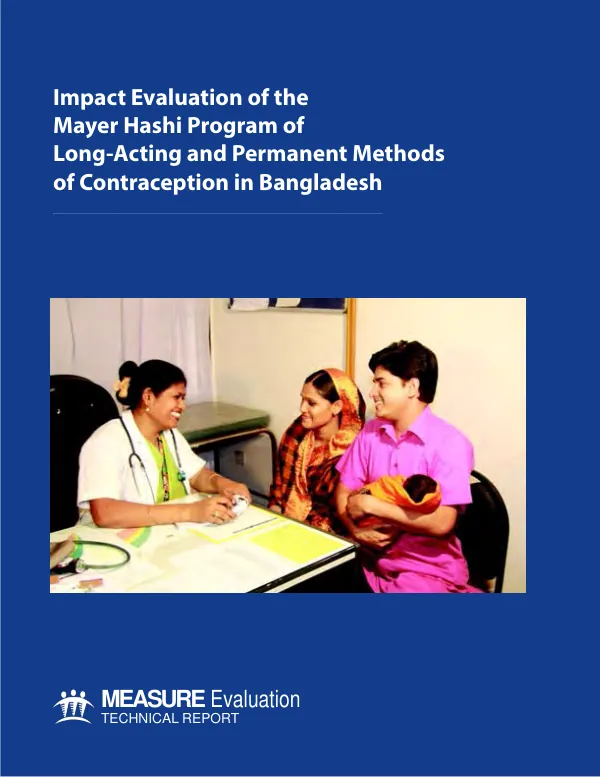
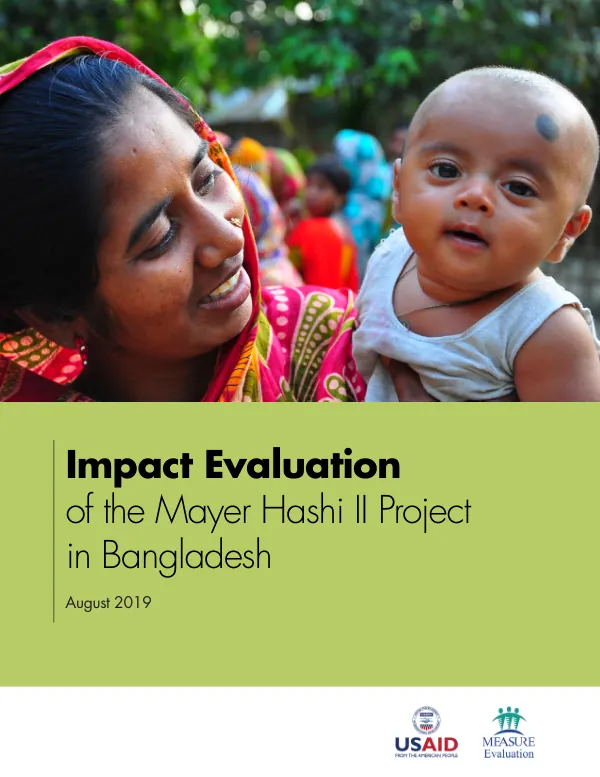
Impact Evaluation of the Mayer Hashi II Project in Bangladesh
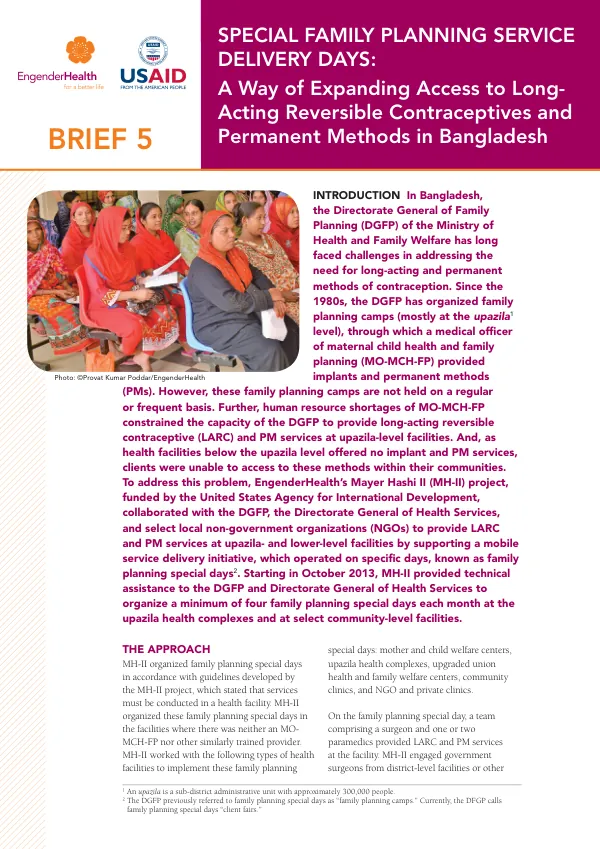
The Mayer Hashi II Project in Bangladesh was a USAID-supported initiative implemented from October 2013 to September 2018.
2019 · 273 pages
Sign in to readA free account is required to download.
Abstract
The project aimed to increase the use of effective family planning (FP) and reproductive health services, with a focus on the informed and voluntary use of long-acting reversible contraceptives (LARCs) and permanent methods (PMs). The project targeted the use of LARCs and PMs at the population level, with a focus on early (Phase I) and late (Phase III) implementation districts. The evaluation used household, provider, and facility surveys conducted in 2015 and 2017 to assess the impact of the project. The surveys were supplemented by qualitative interviews with district family planning managers in 2017 to contextualize the results. The evaluation found that there were no increases in LARC and PM use or in intention to use LARCs and PMs at the population level in Mayer Hashi Phase I or Phase III program areas by 2017. However, the percentage of providers who were trained in LARCs and PMs and PPFP increased notably in both Phase I and Phase III areas. Contextual analysis identified chronic system weaknesses in the provision of LARCs and PMs outside of the project's scope and persistent low demand for LARCs and PMs as impediments to widespread increases in their use. The evaluation highlighted the need for future programs focusing on LARCs and PMs to consider these larger system constraints in their design and expected outcomes. Additionally, the evaluation emphasized the importance of engaging the private sector, given its growing role in healthcare. The project's implementation was supported by the Directorate General of Family Planning (DGFP), Directorate General of Health Services (DGHS), and participating nongovernmental organizations (NGOs) and the private sector. The evaluation team expressed gratitude to the community women and household members who participated in the surveys, as well as the service providers who participated in the facility and provider surveys. The evaluation was conducted by MEASURE Evaluation, a project implemented by the Carolina Population Center, University of North Carolina at Chapel Hill, in partnership with ICF International, John Snow, Inc., Management Sciences for Health, Palladium, and Tulane University. The evaluation team consisted of Mizanur Rahman, PhD (team leader), Siân Curtis, PhD, Rashida E-Ijdi, MSc, Moinuddin Haider, MSc, MPH, Ali Imam, MSS, MPH, Ali Ahmed, MSc, MPH, and Shelah Bloom, PhD. The evaluation's findings and recommendations are presented in the executive summary, which highlights the evaluation's purpose, background, methods, evaluation limitations, key findings, recommendations, and conclusion. The evaluation's results are discussed in detail in the subsequent chapters, which provide an overview of the project's introduction, methods, and results.