KNCV TUBERCULOSIS FOUNDATION
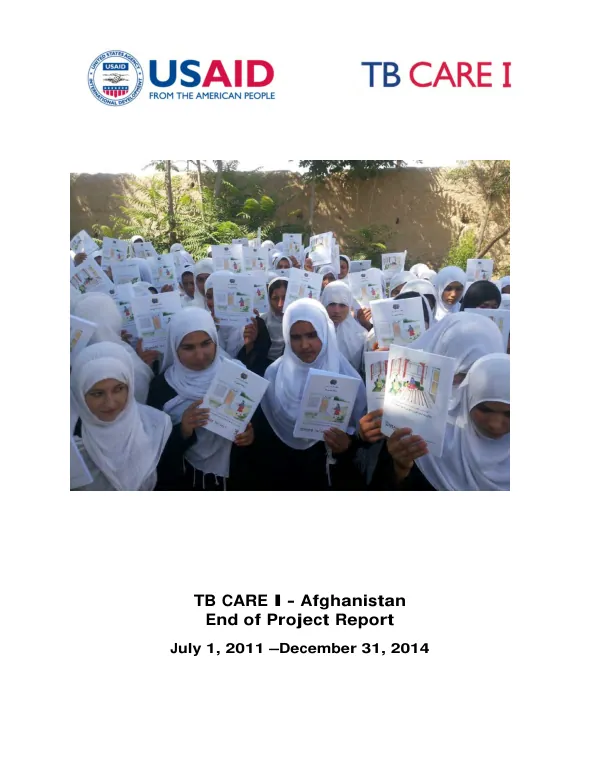
TB CARE I Project – Afghanistan End of Project Report
TB CARE I Project – Afghanistan was a USAID-funded project that operated from July 2011 to December 2014.
2014 · 45 pages
Sign in to readA free account is required to download.
Abstract
The project partnered with the National Tuberculosis Program (NTP), the Ministry of Public Health, and local nongovernmental and international organizations to expand access to TB services in 13 provinces. These provinces included Takhar, Badakhshan, Baghlan, Jowzjan, Faryab, Herat, Kandahar, Ghazni, Paktika, Pakiya, Khost, Kabul, and Bamyan. TB CARE I assisted the NTP to implement Urban directly observed therapy short course (DOTS) and Community-Based DOTS (CB-DOTS) to increase access to TB services. The project also strengthened the health system by revising guidelines on standard operation procedures (SOPs) for case detection and treatment. Additionally, TB CARE I supported the NTP in strengthening monitoring and evaluation, surveillance, operational research, and TB infection control. During the project, the public health care system and the NTP identified 372,803 presumptive TB cases, notified more than 24,000 new sputum smear positive cases, and notified just over 57,000 TB cases of all forms in the 13 project-supported provinces. TB CARE I also assisted the NTP to conduct TB screenings among household contacts of TB patients, which resulted in the identification of 1,007 presumptive cases and notification of 60 TB cases of all forms and 51 bacteriologically confirmed TB cases. The project also supported the NTP's efforts to increase TB case notification through increasing access to quality TB services. The implementation of CB-DOTS continued through partnership with three BPHS implementers in six provinces and BRAC in seven provinces. From 2011 to 2014, in total, 60,541 presumptive TB cases were identified and referred to TB diagnostic centers by community health workers (CHWs). Among them were 3,714 bacteriologically confirmed TB cases (6%) and CHWs put them on treatment. The treatment success rate for those TB patients who received their treatment from CHWs was 98% compared to the national value of 90% for this indicator. Urban DOTS application in facilities resulted in improved access to DOTS through covering 80 (71%) of public and private health facilities. This led to identification of presumptive TB cases and notification of sputum smear positive and other forms of TB cases. For example, during 2011-2014, presumptive TB case identification reached a total of 57,586, up from 11,900 in 2011 to 17,861 in 2014. TB CARE I's efforts to improve TB case notification and treatment outcomes were successful, with the TB case detection rate for all forms of TB increasing from 57% in 2011 to 62% in 2014. The TB case notification trend leveled at 8% annually, while the treatment outcome improved and reached 89% in 2014. In total, 24,814 new sputum smears tested positive and 57,452 of all forms of TB cases were detected in TB CARE I intervention provinces. The project also enhanced the screening of children less than five years of age at TB CARE I intervention areas and screening for this group was significantly higher than the annual target for the fourth year of the project. TB CARE I's support to the NTP's efforts to increase TB case notification through increasing access to quality TB services was successful, with the treatment success rate for those TB patients who received their treatment from CHWs being 98% compared to the national value of 90% for this indicator.
Related documents