USAID DEC
Report on Deliverable 3 and 5: Tool Development for the Early Grade Reading Study (EGRS I), the Reading Support Project (RSP) and Benchmarking
Sign inTHE RESEARCH TRIANGLE INTERNATIONAL INSTITUTE
Report on Deliverable 3 and 5: Tool Development for the Early Grade Reading Study (EGRS I), the Reading Support Project (RSP) and Benchmarking
The Early Grade Reading Study (EGRS) is a research initiative aimed at improving reading outcomes in South African schools.
2021 · 53 pages
Sign in to readA free account is required to download.
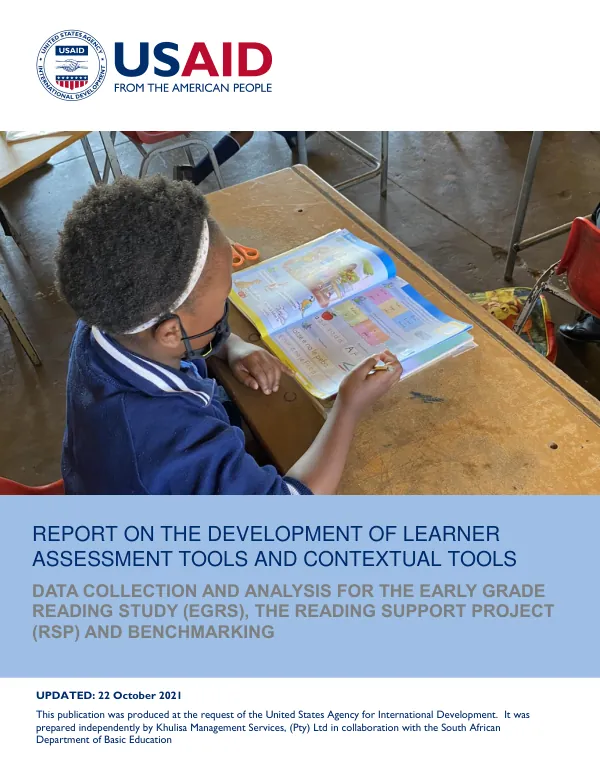
Abstract
The study focuses on the development of learner assessment tools and contextual tools to support data collection and analysis. The report on Deliverable 3 and 5: Tool Development outlines the development process of these tools. The learner assessment instruments include English First Additional Language (EFAL) and Setswana Home Language (HL) learner assessments set at the level of Grade 2, 3, and 6, as well as a Learner COVID questionnaire. These instruments are designed to measure reading proficiency and assess the impact of the Reading Support Project (RSP) on early grade reading outcomes. The contextual tools include questionnaires, surveys, and interview schedules designed to capture information about school context, participation in the RSP, process outcomes, and the impact of COVID-19 on learning. These tools aim to provide insight into the support required to address the challenges posed by the pandemic. The development process of the instruments involved a multi-disciplinary team of specialists, including education researchers, linguists, and experts in assessment development. The team conducted three pilots to refine the instruments and ensure their feasibility for large-scale fieldwork. The report highlights the benefits of conducting three pilots, which provided an opportunity to test and refine the instruments before fieldwork began. The data from the three pilots indicate that the instruments are considered fit for purpose, feasible to implement, and likely to provide the answers required to meet the Task Order objectives. The instruments submitted with this deliverable are the result of a collaborative effort between the research team and the Department of Basic Education. The report acknowledges the contribution of the Ulwazi Lwethu project team and partners, who provided assistance in identifying candidate passages for inclusion in the project. The report also acknowledges the support of the Department of Basic Education officials, who engaged in the development of the tools. The instruments are designed to meet the objectives of Task Order 4: Data Collection and Analysis for the Early Grade Reading Study (EGRS I), the Reading Support Project (RSP), and Benchmarking, and COVID-19 study in 2020. The report concludes that the instruments are considered fit for purpose and are likely to provide the answers required to meet the Task Order objectives. However, it is noted that the instruments may be further refined as fieldwork training takes place.
Related documents
Documents in this collection
 2021
2021USAID DEC
Sustainability Impact Evaluation of the Early Grade Reading Study (EGRS I) and Impact Evaluation of the Reading Support Project (RSP)
Open record 2021
2021USAID DEC