USAID DEC
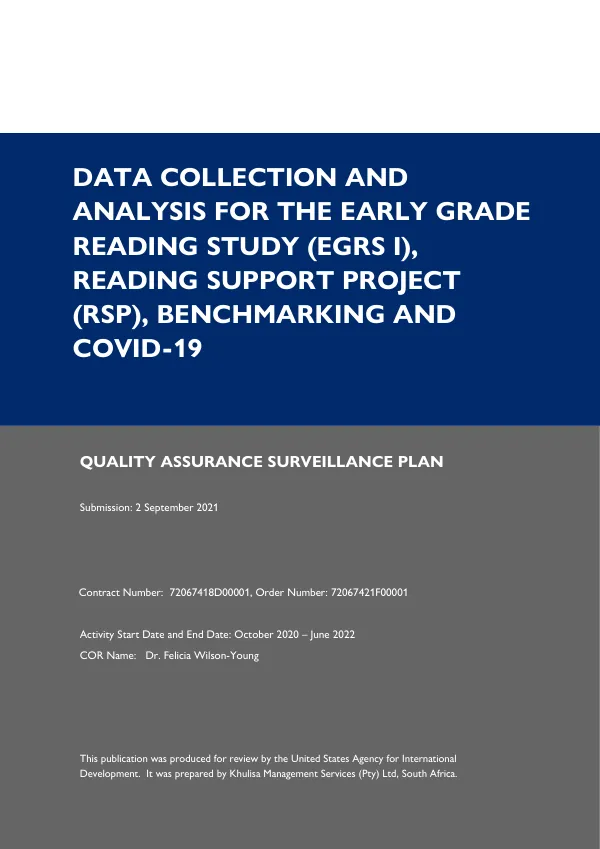
Quality Assurance Surveillance Plan for the Early Grade Reading Study (EGRS), the Reading Support Project (RSP) and Benchmarking
Sign inTHE RESEARCH TRIANGLE INTERNATIONAL INSTITUTE
Quality Assurance Surveillance Plan for the Early Grade Reading Study (EGRS), the Reading Support Project (RSP) and Benchmarking
The Early Grade Reading Study (EGRS) is a research initiative aimed at improving reading outcomes in South African schools.
2021 · 26 pages
Sign in to readA free account is required to download.
Abstract
The study is a Task Order proposal under the Practical Education Research for Optimal Reading and Management: Analyze, Collaborate, Evaluate (PERFORMANCE) Indefinite Delivery Indefinite Quantity (IDIQ) contract. The purpose of this assignment is to contribute to the body of research around early grade reading interventions, establish reading benchmarks in South African Home Languages (HL) and English First Additional Language (EFAL), and conduct research on the psychosocial effects of COVID-19 on early grade reading learning and teaching. The study will be conducted in collaboration with the Department of Basic Education (DBE) and the North-West province Department of Education (PED). The research findings will be directly applicable to the program funders, implementers, and the DBE. The study will also add to the evidence base for policy decisions about the most effective way to support the teaching of Home Language and English as First Additional Language (EFAL) in the Foundation Phase in South Africa. A Quality Assurance Surveillance Plan (QASP) has been developed to guide quality assurance across all elements of the research process. The QASP outlines the roles and responsibilities of team members, including the Contracting Officer Representative (COR), Project Director, Project Manager, Senior Evaluation Specialist, Fieldwork Manager, and Statisticians. The QASP also outlines the procedures for data collection, analysis, and report writing, as well as the arrangements for safeguarding, maintaining, and promoting quality of services or products. The QASP emphasizes the importance of maintaining a desired level of quality in the research process, particularly in the areas of data collection, analysis, and report writing. The plan outlines the procedures for ensuring the accuracy, reliability, and validity of the data, as well as the procedures for addressing any quality control issues that may arise during the research process. The study will be conducted over a period of 20 months, from October 2020 to June 2022. The research team will consist of experts in education research, statistics, and fieldwork management. The team will be responsible for developing and implementing the QASP, as well as ensuring the quality of the research process. The QASP will be reviewed and updated regularly to ensure that it remains relevant and effective in guiding the research process. The plan will also be used to provide feedback to the research team and to ensure that the research findings are of high quality and meet the requirements of the study. The study will contribute to the body of research around early grade reading interventions and will provide valuable insights into the effectiveness of different approaches to improving reading outcomes in South African schools. The research findings will be used to inform policy decisions and to improve the quality of education in South Africa. The QASP outlines the procedures for addressing any quality control issues that may arise during the research process. The plan emphasizes the importance of maintaining a desired level of quality in the research process, particularly in the areas of data collection, analysis, and report writing. The QASP will be reviewed and updated regularly to ensure that it remains relevant and effective in guiding the research process. The study will be conducted in accordance with the QASP, which outlines the procedures for ensuring the accuracy, reliability, and validity of the data. The plan also outlines the procedures for addressing any quality control issues that may arise during the research process. The QASP will be used to provide feedback to the research team and to ensure that the research findings are of high quality and meet the requirements of the study. The research team will consist of experts in education research, statistics, and fieldwork management. The team will be responsible for developing and implementing the QASP, as well as ensuring the quality of the research process. The QASP will be reviewed and updated regularly to ensure that it remains relevant and effective in guiding the research process.