USAID DEC
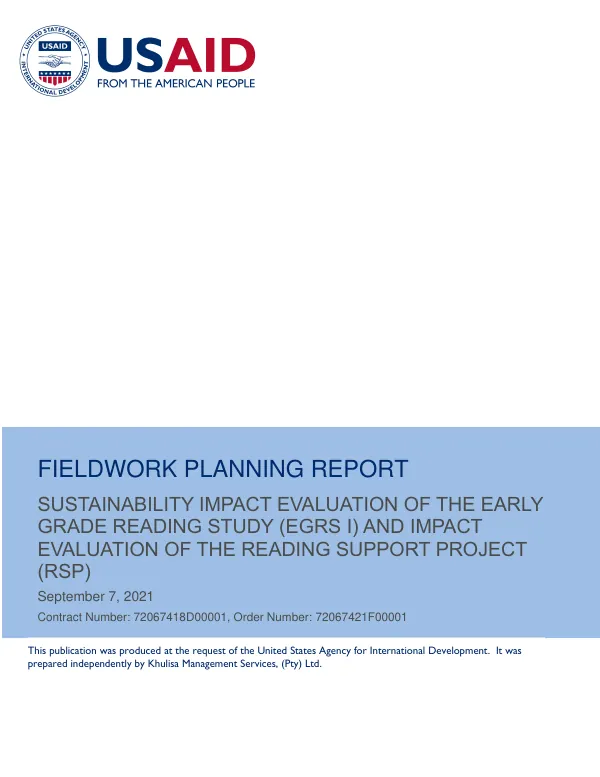
Sustainability Impact Evaluation of the Early Grade Reading Study (EGRS I) and Impact Evaluation of the Reading Support Project (RSP)
Sign inTHE RESEARCH TRIANGLE INTERNATIONAL INSTITUTE
Sustainability Impact Evaluation of the Early Grade Reading Study (EGRS I) and Impact Evaluation of the Reading Support Project (RSP)
The Early Grade Reading Study (EGRS) I and the Reading Support Project (RSP) were initiated to address the challenge of children not learning to read for understanding.
2021 · 29 pages
Sign in to readA free account is required to download.
Abstract
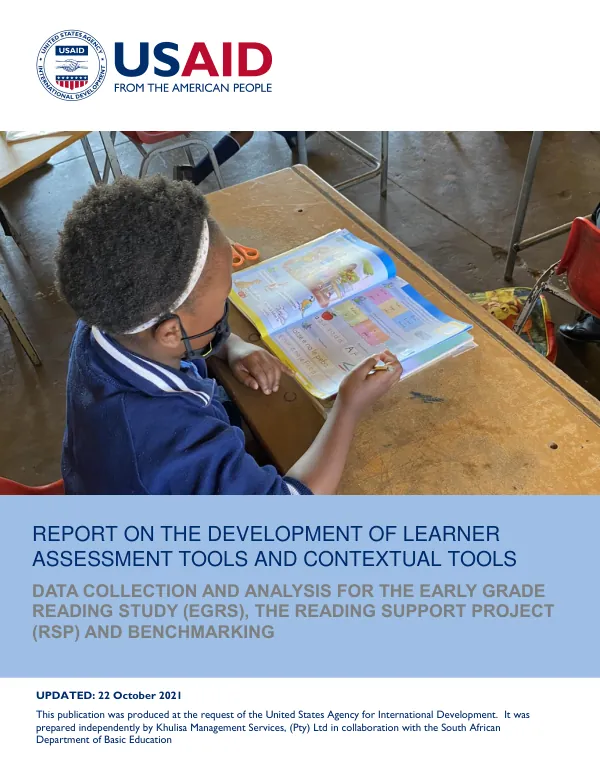
The EGRS evaluated three Setswana Home Language interventions aimed at improving reading in the early grades, implemented in two districts in the North West province of South Africa. The interventions showed significant impacts on learner results when teachers benefited from training, coaching, and provision of learning materials. The EGRS Wave 4 evaluation, conducted in 2018, showed that the initial impacts of the EGRS on learners' ability to read continued one year beyond the end of the intervention. In response to this finding, USAID and the Foundation for Professional Development (FPD) Consortium modified the existing RSP to include selected EGRS components. The RSP was implemented in 164 of the original 230 EGRS schools, with a further 50 schools serving as controls. Khulisa Management Services, in collaboration with the DBE and USAID, conducted a sustainability impact evaluation of the EGRS I and an impact evaluation of the RSP. The research aimed to determine if the reading gains made by learners who benefited from the EGRS had been sustained between 2018 and 2021, and if the RSP led to early grade reading gains of learners. The data collection for the impact evaluations was expanded to establish letter-sound benchmarks and oral reading fluency thresholds and benchmarks for the early grades in Setswana and EFAL. The beginning of 2020 marked the beginning of the COVID-19 pandemic, which significantly disrupted schooling. The effect of missed time in school and the psychosocial impact of COVID-19 will be researched and analyzed in tandem with the data collection and analysis for EGRS and RSP. The fieldwork planning report presents the planning activities and risk mitigation strategies to conduct the fieldwork in 229 schools in the North West district in 2021. The Fieldwork Manual was developed to explain how Fieldworkers should administer the fieldwork for the Data Collection and Analysis for EGRS, RSP, a COVID-19 study, and Benchmarking. The manual includes important information about ethical requirements when collecting data, how to conduct fieldwork, how to undertake sampling, and how to administer learner assessments. The manual also provides an overview of the project and the data collection, and explains the role of the fieldworkers and their responsibilities. The Fieldworker Manual was updated based on the experience from Wave 4 of data collection of EGRS I. The manual went through three iterations: initial updating prior to Pilot 2, inclusion of feedback from Pilot 2 and preparation for Pilot 3, and updating of the manual based on amendments to tools. The manual details the process fieldworkers must implement before going to a school, when they arrive at the school, and the two-day fieldwork schedule. The daily programme for the school is included on pages 14 to 17 in the manual. The fieldwork planning report aims to document the preparation undertaken prior to the actual fieldwork being conducted. A final fieldwork report, detailing the process, successes, challenges, and lessons, will be produced at the end of the fieldwork. The final report will reflect further on the fieldwork preparation and provide any additional lessons and recommendations. The fieldwork will be conducted in 229 schools in the North West district in 2021. The fieldworkers will be responsible for administering the learner assessments, collecting data, and ensuring that the fieldwork is conducted in accordance with the Fieldwork Manual. The fieldwork will be conducted in a COVID-19-safe environment, and the fieldworkers will be required to follow the COVID-19 protocols and the Research Distress Protocol. The data collection for the impact evaluations will be expanded to establish letter-sound benchmarks and oral reading fluency thresholds and benchmarks for the early grades in Setswana and EFAL. The research aims to fill an important gap in the existing research on early grade reading in South Africa. The findings of the research will contribute to the body of research around early grade reading interventions and will inform policy and practice in the education sector.