CHEMONICS
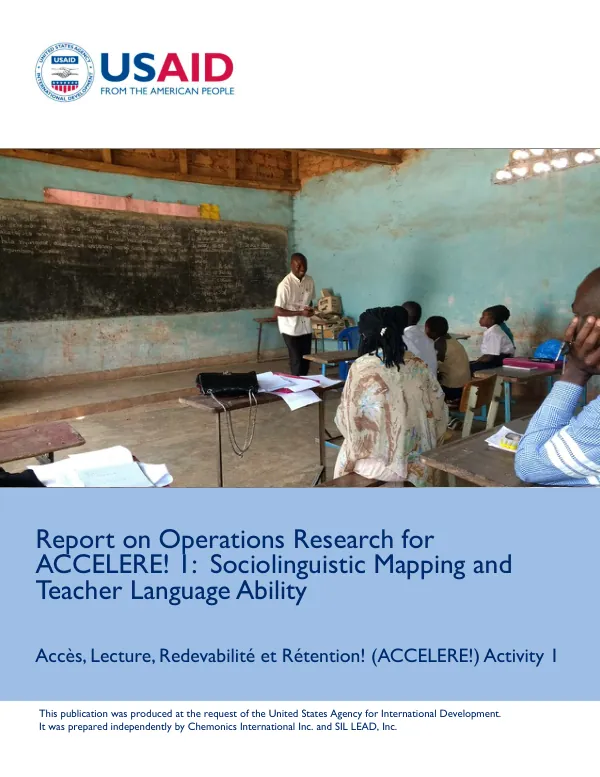
Report on Sociolinguistic Mapping and Teacher Language Ability – ACCELERE! 1
The ACCELERE!
2018 · 42 pages
Sign in to readA free account is required to download.
Abstract
1 activity aims to improve early grade educational outcomes in the Democratic Republic of Congo (DRC) by using local languages as primary media of instruction. This report focuses on sociolinguistic mapping and teacher language ability in five provinces: Sud Ubangi, Equateur, Lualaba, Haut-Katanga, and Kasai Oriental. The study found that the local language, known as the langue nationale, is more widely spoken and understood than French in every province. Teachers in these provinces speak the langue nationale fluently, and the majority have positive attitudes towards its use in education. However, the main challenge lies in Swahili-speaking areas, where the level of difference between the local form of the language and the standard variety used in school is vast. Children's competence in the local variety of the langue nationale varies widely between and within provinces, particularly in rural contexts. The biggest challenge lies in Sud Ubangi, where the majority of rural children do not adequately speak or understand the langue nationale, which is Lingala in this case. In contrast, Kasai Oriental presents the least linguistic or sociolinguistic challenges to the implementation of the policy. Significant issues with children's understanding of the langue nationale are also found in rural Lualaba and rural Equateur. In Swahili-speaking Lualaba and Haut-Katanga, the variety of Swahili used in school presents significant problems of understanding. Two potential solutions are adapting school materials to the linguistic background of the children while maintaining the standard form, or teaching in a variety closer to the local variety. Based on this analysis, two main recommendations are proposed. Firstly, considering the use of Ngbaka as a medium of instruction in most rural schools in Sud Ubangi, where most children do not come to school with sufficient Lingala to follow what is happening in school in the early grades. Similar challenges are found in the provinces of Lualaba, Equateur, and Haut Katanga, but for a minority rather than a majority of children in those cases. Secondly, developing appropriate learning materials and resources for Swahili-speaking teachers and pupils in the provinces of Lualaba and Haut-Katanga, due to the significant difference between the local varieties of Swahili and the variety taught in school. This should involve the development of materials that leverage the similarities that exist and enable children to learn the distinctive forms found in school materials in a structured way. Some consideration could also be given to the use of local linguistic forms, if deemed appropriate.
Related documents