USAID DEC
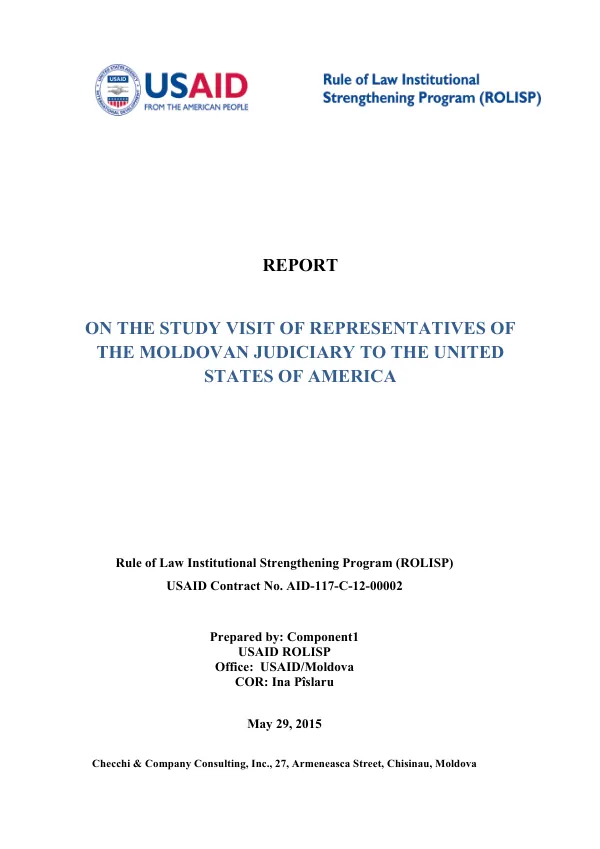
Report on the Study Visit of Representatives of the Moldovan Judiciary to the United States
Sign inCHECCHI AND COMPANY, CONSULTING, INC.
Report on the Study Visit of Representatives of the Moldovan Judiciary to the United States
The study visit of representatives of the Moldovan judiciary to the United States was organized by the Rule of Law Institutional Strengthening Program (ROLISP) under the USAID Contract No.
2015 · 24 pages
Sign in to readA free account is required to download.
Abstract
AID-117-C-12-00002. The visit aimed to provide Moldovan judicial representatives with an opportunity to learn about modern court administration practices and the tools for assessing the performance of courts, the use of information technologies, and the collection, use, and analysis of statistical data in the US judiciary. The participants, including senior judges and Chiefs of court secretariats, SCM, and Department of Judicial Administration staff, met with various judicial institutions during their trip, such as the Administrative Office of the Maryland Courts in Annapolis, Maryland; the Montgomery County Circuit Court of Maryland; the Administrative Offices of the US Courts in Washington D.C.; the Center for Legal and Court Technology at the College of William and Mary; the National Center for State Courts; and the Administrative Offices of the Arizona Courts. During their visit to the Administrative Office of the Maryland Courts, the delegation learned about the Maryland judiciary's mission to provide fair, efficient, and effective justice for all. They were introduced to MDEC, a new electronic case management software that is a completely digitalized, paper-less system. The Maryland courts examine over 2 million cases annually, with the federal system examining approximately 5% of all cases. Every judge in Maryland examines an average of 2000 cases per year, and the budget of the Administrative Office of the Maryland Courts is $0.5 billion. The Maryland judiciary has also implemented various services for the public, including live chats, help lines, and special email addresses to answer citizens' questions. The HR management system currently works on paper-based documents but will be replaced by an online system, PeopleSoft, in January 2016. The judiciary in Maryland has a case search engine, and there are 1.5 to 2 million searches on this website daily. During their visit to the Montgomery County Circuit Court, the delegation learned about the court's data-driven approach to judicial administration, which increases accountability and transparency through information sharing and leads to public trust and confidence in the judicial processes. The court uses a case assignment software managed by the court and follows the principle of 1 family - 1 judge, meaning that the same judge examines all cases related to the members of the same family. The Montgomery County Circuit Court uses the Differentiated Case Management technique to tailor the case management process and the allocation of judicial system resources to the needs of individual cases. The court operates in 2 buildings, with 22 judges and 5 special judges, and has approximately 1000 jurors visit the court every week. The court has separate secure access areas for court staff and detainees, witnesses, or their relatives, and is equipped with modular microphones and wireless headphones for hearing-impaired persons. Humidity is constantly monitored in the courtrooms to ensure a comfortable environment for participants. The study visit provided Moldovan judicial representatives with valuable insights into modern court administration practices and the tools for assessing the performance of courts, the use of information technologies, and the collection, use, and analysis of statistical data in the US judiciary. The visit aimed to promote transparency and accountability in the Moldovan judiciary and to provide a well-balanced view of various aspects related to modern and efficient court administration used by the US judiciary.
Related documents