USAID DEC
Rescission of the Mexico City Policy and Assistance for Voluntary Population Planning
Sign inUNITED NATIONS FUND POPULATION
Rescission of the Mexico City Policy and Assistance for Voluntary Population Planning
The Mexico City Policy, also known as the Global Gag Rule, was first introduced in 1985 by President Ronald Reagan.
2009 · 2 pages
Sign in to readA free account is required to download.
Abstract
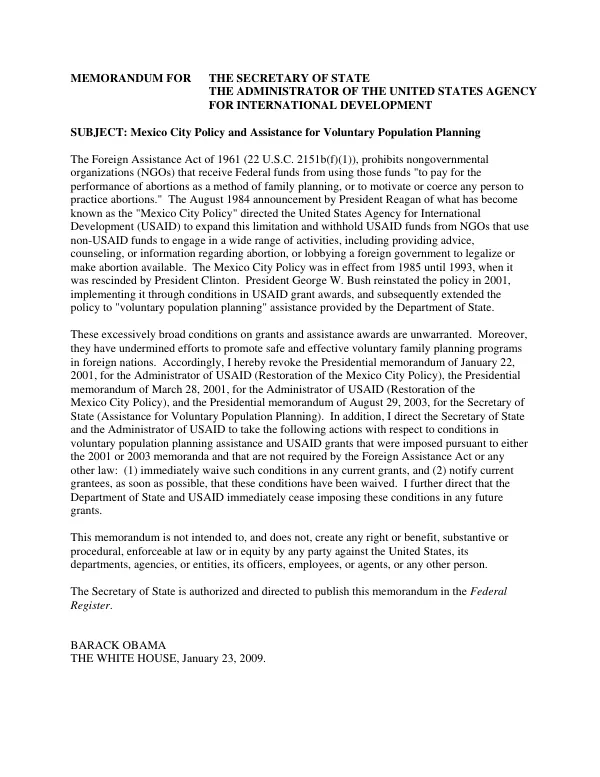
This policy prohibited nongovernmental organizations (NGOs) that received Federal funds from using those funds to pay for abortions as a method of family planning or to motivate or coerce any person to practice abortions. The policy was expanded to withhold USAID funds from NGOs that used non-USAID funds to engage in a wide range of activities, including providing advice, counseling, or information regarding abortion, or lobbying a foreign government to legalize or make abortion available. The policy was in effect until 1993, when it was rescinded by President Bill Clinton. President George W. Bush reinstated the policy in 2001, implementing it through conditions in USAID grant awards, and subsequently extended the policy to "voluntary population planning" assistance provided by the Department of State. These conditions were excessively broad and unwarranted, undermining efforts to promote safe and effective voluntary family planning programs in foreign nations. On January 23, 2009, President Barack Obama revoked the Presidential memoranda of January 22, 2001, and March 28, 2001, for the Administrator of USAID, as well as the Presidential memorandum of August 29, 2003, for the Secretary of State. The revocation aimed to immediately waive conditions in current grants and notify current grantees that these conditions had been waived. The Department of State and USAID were also directed to cease imposing these conditions in any future grants. The rescission of the Mexico City Policy was intended to promote safe and effective voluntary family planning programs in developing countries. President Obama stated that the policy had been used as a political wedge issue, dividing the country and undermining efforts to protect and empower women and promote global economic development. He directed his staff to initiate a fresh conversation on family planning, working to find areas of common ground to best meet the needs of women and families at home and around the world. The policy change aimed to reduce unintended pregnancies, promote safe motherhood, reduce maternal and infant mortality rates, and increase educational and economic opportunities for women and girls. The United States also resumed funding to the U.N. Population Fund, joining 180 other donor nations working collaboratively to reduce poverty, improve the health of women and children, prevent HIV/AIDS, and provide family planning assistance to women in 154 countries.