USAID DEC
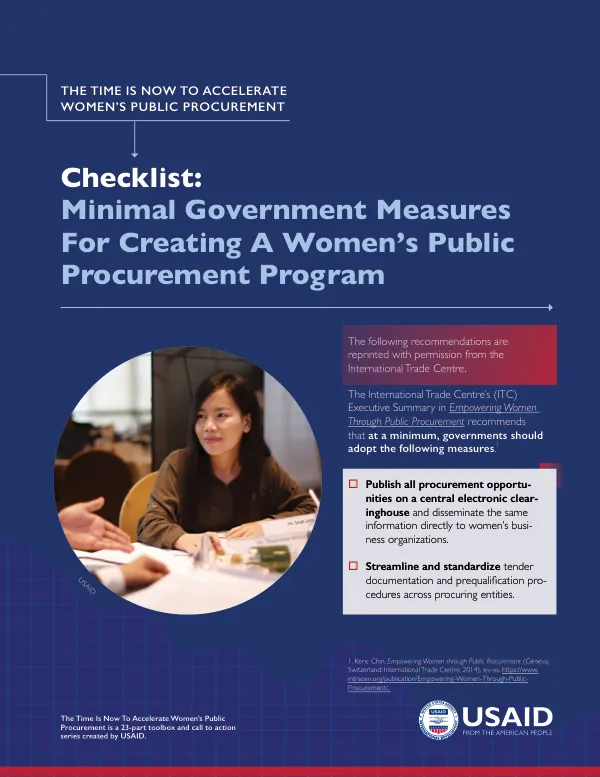
The Time is Now to Accelerate Women's Public Procurement: Checklist: Minimal Government Measures for Creating a Women's Public Procurement Program
Sign inBANYAN GLOBAL
The Time is Now to Accelerate Women's Public Procurement: Checklist: Minimal Government Measures for Creating a Women's Public Procurement Program
Agricultural development initiatives in Rwanda aimed to improve crop yields and market access for smallholder farmers.
2021 · 2 pages
Sign in to readA free account is required to download.
Abstract
More than 2,500 farmers received training in sustainable agriculture techniques, with 38% being women-headed households. The program's success was attributed to the integration of women's empowerment and market access interventions. The International Trade Centre's Executive Summary in Empowering Women Through Public Procurement recommends that governments adopt measures to increase women's participation in public procurement. These measures include publishing procurement opportunities on a single platform, streamlining tender documentation, and permitting women-owned businesses to prequalify for contracts. The report emphasizes the importance of providing meaningful feedback to unsuccessful bidders and implementing rules for prompt payment to women-owned businesses. Public procurement experts at Canada's Telfer School of Management have developed strategies to increase diversity among small and medium-sized enterprise suppliers to the government. These strategies include benchmarking small and medium-sized enterprises as suppliers, promoting innovation, and encouraging international trade. The study, Benchmarking Small and Medium Enterprises as Suppliers to the Government of Canada, highlights the importance of addressing barriers faced by women-owned businesses in accessing public procurement.
Connected topics
Related documents