INTER-AMERICAN DEVELOPMENT BANK
Revenue Administration in Latin America and the Caribbean
Revenue Administration in Latin America and the Caribbean is a critical component of economic development in the region.
2014 · 1 pages
Sign in to readA free account is required to download.
Abstract
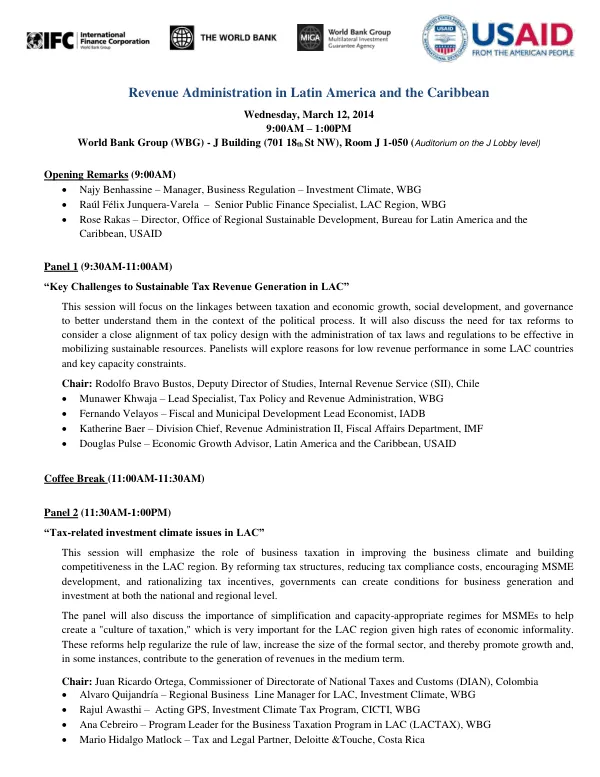
The World Bank Group (WBG) convened a meeting on March 12, 2014, to discuss key challenges to sustainable tax revenue generation in the region. Najy Benhassine, Manager of Business Regulation and Investment Climate at the WBG, and Raúl Félix Junquera-Varela, Senior Public Finance Specialist in the LAC Region at the WBG, delivered opening remarks. Rose Rakas, Director of the Office of Regional Sustainable Development at the Bureau for Latin America and the Caribbean, USAID, also participated in the opening session. The first panel, "Key Challenges to Sustainable Tax Revenue Generation in LAC," focused on the linkages between taxation and economic growth, social development, and governance. Panelists explored reasons for low revenue performance in some LAC countries and key capacity constraints. Rodolfo Bravo Bustos, Deputy Director of Studies at the Internal Revenue Service in Chile, chaired the panel. Munawer Khwaja, Lead Specialist in Tax Policy and Revenue Administration at the WBG, Fernando Velayos, Fiscal and Municipal Development Lead Economist at the Inter-American Development Bank, Katherine Baer, Division Chief in Revenue Administration II at the Fiscal Affairs Department of the International Monetary Fund, and Douglas Pulse, Economic Growth Advisor at USAID, participated in the discussion. The second panel, "Tax-related investment climate issues in LAC," emphasized the role of business taxation in improving the business climate and building competitiveness in the region. Panelists discussed the importance of simplification and capacity-appropriate regimes for micro, small, and medium-sized enterprises (MSMEs) to help create a "culture of taxation." This is particularly relevant in the LAC region, where high rates of economic informality are prevalent. By reforming tax structures, reducing tax compliance costs, encouraging MSME development, and rationalizing tax incentives, governments can create conditions for business generation and investment at both the national and regional level. Juan Ricardo Ortega, Commissioner of the Directorate of National Taxes and Customs in Colombia, chaired the panel. Alvaro Quijandría, Regional Business Line Manager for LAC at the WBG, Rajul Awasthi, Acting GPS at the Investment Climate Tax Program, CICTI, WBG, Ana Cebreiro, Program Leader for the Business Taxation Program in LAC (LACTAX) at the WBG, and Mario Hidalgo Matlock, Tax and Legal Partner at Deloitte & Touche in Costa Rica, participated in the discussion.