USAID. MISSION TO ECUADOR
Revenue generation for development (Ministry of Finance component)
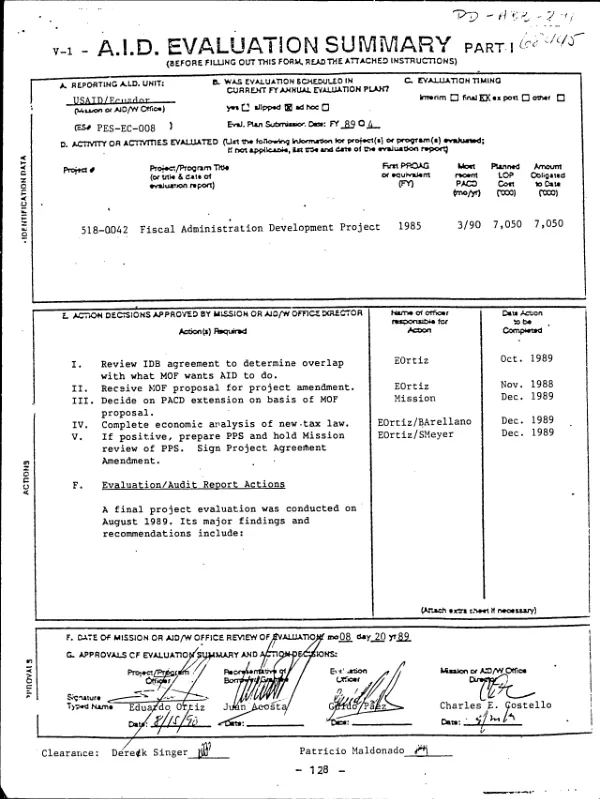
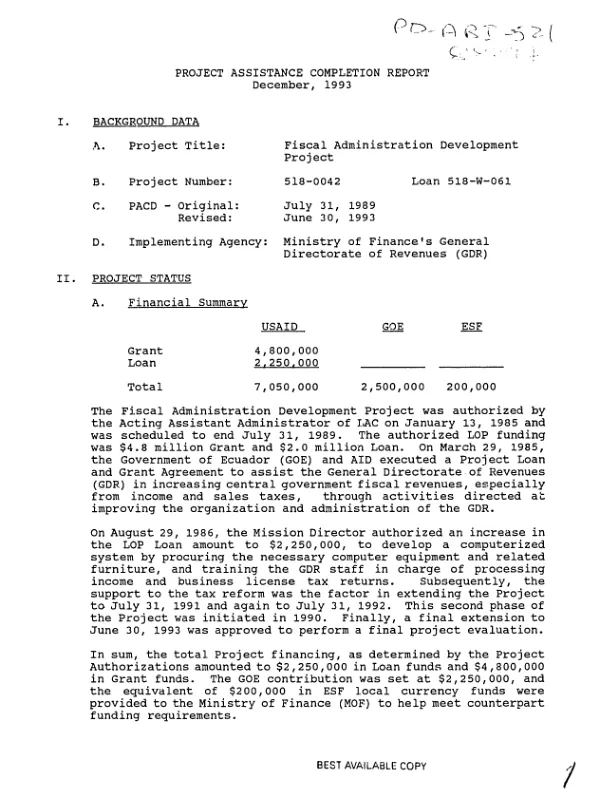
Evaluates project component to help the Government of Ecuador"s (GOE) Ministry of Finance (MOF) increase revenues by improving tax administration.
Garza, Leopoldo; Roeser, Randy · 1986
Sign in to readA free account is required to download.
Abstract
Final PES covers the period 8/83-6/85 and is based on advisors" final reports and interviews with project and MOF personnel. The project, a pilot effort, increased revenue generation by S/495.5 million as of 4/85 (57% above target) and proved that such increases can be achieved through administrative "quick fixes," but most importantly, it set the stage for a follow-on effort which can have a much more significant impact on GOE revenues. Pilot programs to detect three types of taxpayer noncompliance (nonfiling, delinquent collections, and underreporting) have been implemented, procedures for processing returns more efficiently (including minicomputer processing) have been set up, a study on reorganization of MOF tax administrative units was completed, and short-term training was given to 61 managers (vs. 32 targeted) and on-the-job training and seminars to many more. These experiences have had a notable effect on the motivation and productivity of mid- and upper-level MOF personnel. The only significant external factor was the change in government in 8/84; low morale and a sense of uncertainty among bureaucrats during the interregnum caused a temporary decline in revenues generated but did not delay implementation or alter assumptions relating to the project"s feasibility. The new government has readily accepted the value of the pilot programs and enthusiastically welcomed a follow-on project to address more fundamental bureaucratic and policy constraints - uncovered during this project - to revenue increases. The project taught the value of a pilot approach. Not only was A.I.D. able to test the potential for improved tax administration without making a long-term large commitment, but implementation toward the end of one administration provided a base upon which to open dialogue with the incoming administration; as a result the new project will be implemented almost entirely during the tenure of the administration that requested it. The project also shows that in order to maximize a pilot"s demonstration effect, "experimental" conditions must be maintained, i.e., project advisors should vigilantly resist pressures to make pilot activities part of the normal governmental structure.
Related documents