USAID DEC
Estrategias basadas en evidencia para la racionalización de la lista de medicamentos de alto costo en la Republica Dominicana
Sign inMANAGEMENT SCIENCES FOR HEALTH
Estrategias basadas en evidencia para la racionalización de la lista de medicamentos de alto costo en la Republica Dominicana
The Ministry of Public Health (MSP) of the Dominican Republic established the Program of High-Cost Medicines (PMAC) in 2008 to facilitate clinical care for patients with rare and costly diseases, such as refractory cancers, rheumatoid arthritis, hepatitis C, and renal transplants.
2015 · 3 pages
Sign in to readA free account is required to download.
Abstract
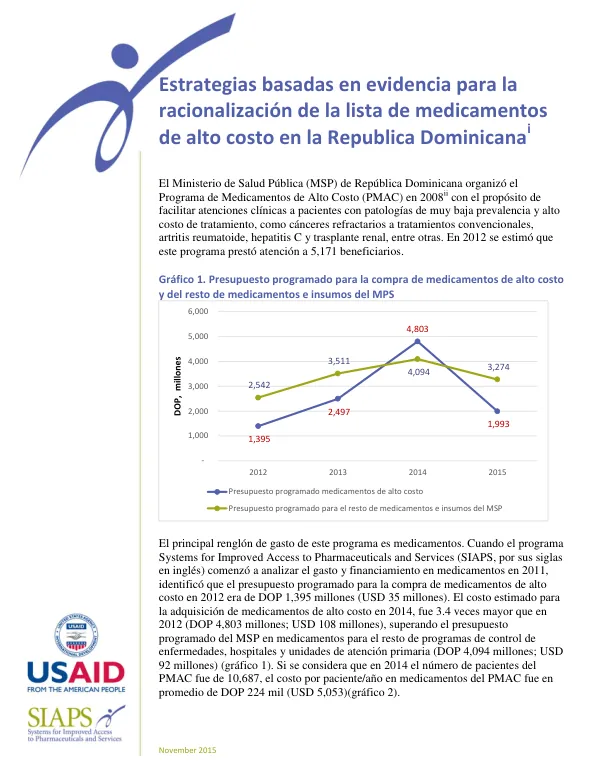
By 2012, the program had provided care to 5,171 beneficiaries. The primary expenditure of this program is on medications. In 2011, the Systems for Improved Access to Pharmaceuticals and Services (SIAPS) began analyzing the expenditure and financing of medications and identified that the budgeted amount for the purchase of high-cost medicines in 2012 was DOP 1,395 million (USD 35 million). The estimated cost for the acquisition of high-cost medicines in 2014 was 3.4 times higher than in 2012, at DOP 4,803 million (USD 108 million), exceeding the MSP's budget for medications for the rest of disease control programs, hospitals, and primary care units (DOP 4,094 million; USD 92 million). The cost per patient per year for medications in the PMAC was, on average, DOP 224,000 (USD 5,053) in 2014. In 2012, the MSP requested technical assistance from SIAPS to review the list of 98 high-cost medicines as a strategy to optimize and rationalize expenditure. The implemented strategy consisted of two stages. The first stage involved a review of international reference lists and scientific literature by a pharmacoepidemiologist to identify therapeutic benefits, safety, costs, and potential therapeutic alternatives of the products included in the list. Based on this information, the pharmacoepidemiologist recommended their permanence, exclusion, or substitution. The second stage involved a review and validation of the proposal by a consultation group that included clinical specialists who served as advisors to the PMAC and international consultants with expertise in the subject. The consultation group agreed by consensus not to consider 45 medicines in the estimation of needs for 2015 (graph 3), for a potential reduction in cost compared to 2014 of approximately DOP 893 million (USD 20 million). During the review, a prioritization was established for the acquisition of the remaining 53 medicines. Considering the financial ceilings for purchase in 2015 and the implementation of price negotiation strategies, the final purchase plan included 42 medicines, at an estimated cost of DOP 1,993 million (USD 45 million) (graph 3). The budgeted amount for the purchase of high-cost medicines in 2015 had a reduction of DOP 2,810 million (USD 62 million) compared to 2014. The MSP and SIAPS implemented an algorithm for decision-making to review the list of high-cost medicines, which included the following criteria: inclusion in international reference lists, evidence of scientific effectiveness, and availability of budgetary resources. Based on these criteria, the consultation group agreed to exclude 45 medicines from the list, which would result in a potential reduction in cost of approximately DOP 893 million (USD 20 million) compared to 2014. The final purchase plan included 42 medicines, at an estimated cost of DOP 1,993 million (USD 45 million).