USAID DEC
Review report : Southern Africa Centre for Co-operation in Agricultural Reserach [i.e. Research] and Training (SACCAR)
Sign inSOUTHERN AFRICAN CENTRE FOR COOPERATION IN AGRICULTURAL RESEARCH AND TRAINING
Review report : Southern Africa Centre for Co-operation in Agricultural Reserach [i.e. Research] and Training (SACCAR)
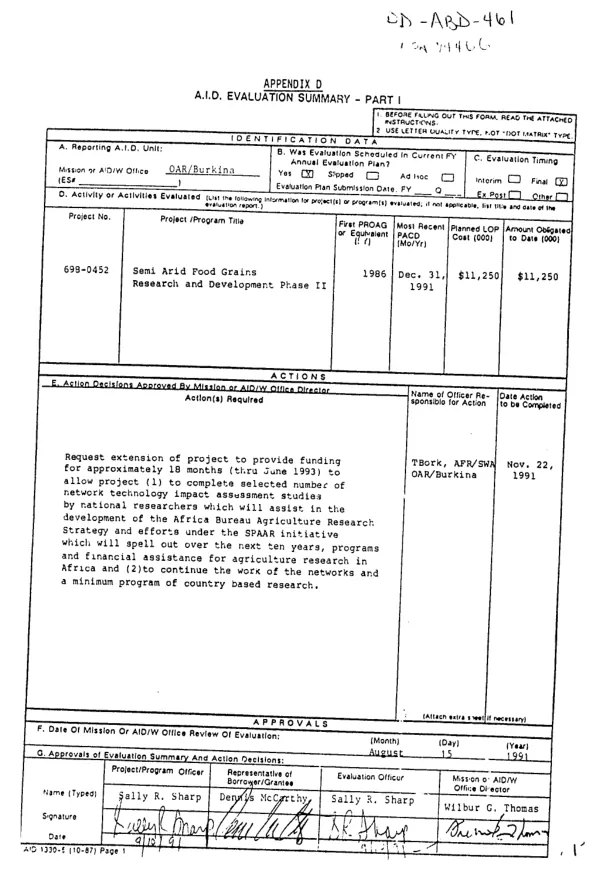
Evaluates a multi-donor project to establish a Southern African Centre for Cooperation in Agricultural Research (SACCAR) to serve member states of the Southern African Development Coordination Conference (SADCC).
1991
Sign in to readA free account is required to download.
![Review report : Southern Africa Centre for Co-operation in Agricultural Reserach [i.e. Research] and Training (SACCAR)](https://covers.devme.ai/gen/24664.webp)
Abstract
Final evaluation covers Phase I of the project (1984-1991). Overall, SACCAR is an efficient organization, has the support of SADCC countries, and is achieving its objectives. The Centre is currently coordinating nine projects and subprojects being implemented by separate agencies, mostly international agricultural research centers (IARC"s). Donor funding should be extended for a second 5-year phase. SACCAR"s mandate has expanded from its original focus on coordinating regional research in food crops -- an area in which it has enjoyed considerable success -- to include research in agricultural production (including natural resources) and advanced agricultural training. Pressure to expand its mandate still further, to cover agricultural extension and policy analysis, should be resisted, as it may detract from SACCAR"s efficiency, one of its most valuable characteristics. So far, SACCAR management has operated on the basis of consensus. However, this rather unstructured approach will not be adequate in the future. Areas requiring strengthening include work plans, personnel management, and financial management. In its role as research coordinator, SACCAR has done well in identifying research projects, soliciting donor funding, and coordinating the implementation of projects with donors and with national and international research organizations. During Phase II, SACCAR needs to emphasize sustainability of regional research projects. This will require SACCAR to: shift from a project focus to promotion of regional research networks; address natural resources management issues; and adopt a systems rather than commodity approach to project design and implementation. SACCAR has supported general training activities (workshops, seminars, and conferences), as well as two important programs addressing specific, formal training needs (In-Service Agricultural Research Management Training, and the Regional Programme for Strengthening Agricultural Faculties). The latter programs, however, have required a great deal of direct management from SACCAR, which should devolve this responsibility to other entities as soon as possible. Also, SACCAR lacks an adequate mechanism for coordinating its training activities and for evaluating the impact of training. The problem of language barriers to project participation by Lusophone citizens of Angola and Mozambique is particularly acute in the training area and requires study. SACCAR"s initiatives in database development have been welcome, but require updating and consolidation, and SACCAR"s information dissemination activities, while essential, are time-consuming and should be subcontracted where possible.

![Development plan for the Arid Zone Research Institute [AZRI]](https://covers.devme.ai/gen/72478.webp)
![Work plan for the NARP research grants program -- part A : for non-ARC [Ministry of Agriculture and Land Reclamation, Agricultural Research Center] agricultural research institutions in Egypt](https://covers.devme.ai/gen/81448.webp)