USAID. MISSION TO BOTSWANA
Regional agricultural research coordination
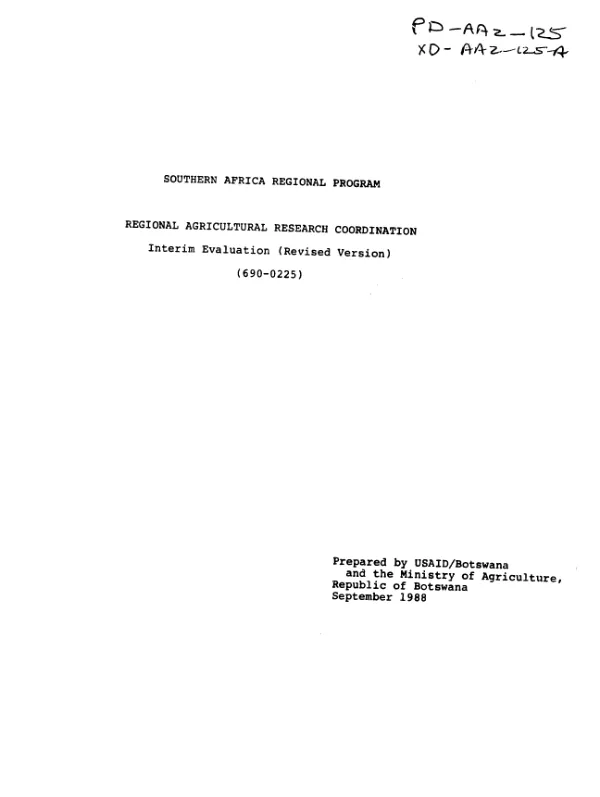
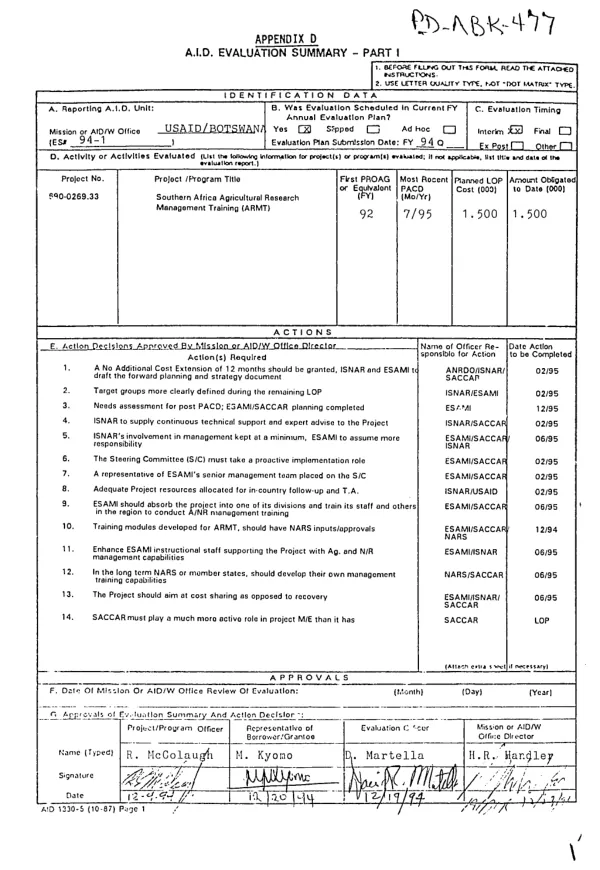
Summarizes interim evaluation (XD-AAZ-125-A) of a project to assist the Southern African Development Coordination Conference (SADCC) in the establishment of a Southern African Centre for Cooperation in Agricultural Research (SACCAR) to coordinate activities among the 9 SADCC members.
1989
Sign in to readA free account is required to download.
Abstract
The evaluation covers the period FY84-FY89. The project is well-implemented and is strengthening national agriculture and natural resource research and training institutions. SACCAR"s workshops, seminars, and steering committees are universally praised by administrators and technicians. The in-country, graduate, and personnel development training programs and regional workshops are highly regarded and participants have established contacts with other scientists and technicians in the region. Technical advisory panels are effectively providing project monitoring and strategy guidance and, along with commodity-specific steering committees, they are functioning as channels for regional and national coordination. SACCAR"s networking system has facilitated identification of regional and national priorities for research and training and, although complicated, could be effectively extended to other SADCC sub-sectors. Networking among members of institutions and agencies has produced a spirit of cooperation and cohesiveness as individuals get to know one another and develop a sense of ownership in SACCAR. Recommendations are to: (1) emphasize mid- and long-term planning and strategy development; (2) formalize operational guidelines and delegate more coordination responsibilities to national collaborators; (3) institutionalize a system for developing yearly workplans and budgets by regional sub-projects; (4) reconsider funding of the sociological, cultural, and impact project; (5) collaborate rather than compete with national systems for scarce resources; (6) include agricultural extension linkages in SACCAR"s coordination and training mandate; and (7) increase Mission support for cooperation between SACCAR and the executing agencies (EA"s). It is also recommended that a 2-year, no-cost project extension be considered. Two important lessons were learned. (1) A formal and uniform regional coordinating system is necessary to efficiently coordinate and control donor and EA activities as well as national systems. (2) Cooperation and coordination must be based on strengthening national capabilities so that they can contribute to and use assistance effectively.
![Review report : Southern Africa Centre for Co-operation in Agricultural Reserach [i.e. Research] and Training (SACCAR)](https://covers.devme.ai/gen/24664.webp)