USAID
Revised NRM Guidance for Clearance
Natural resource management is a critical component of the U.S.
2023 · 11 pages
Sign in to readA free account is required to download.
Abstract
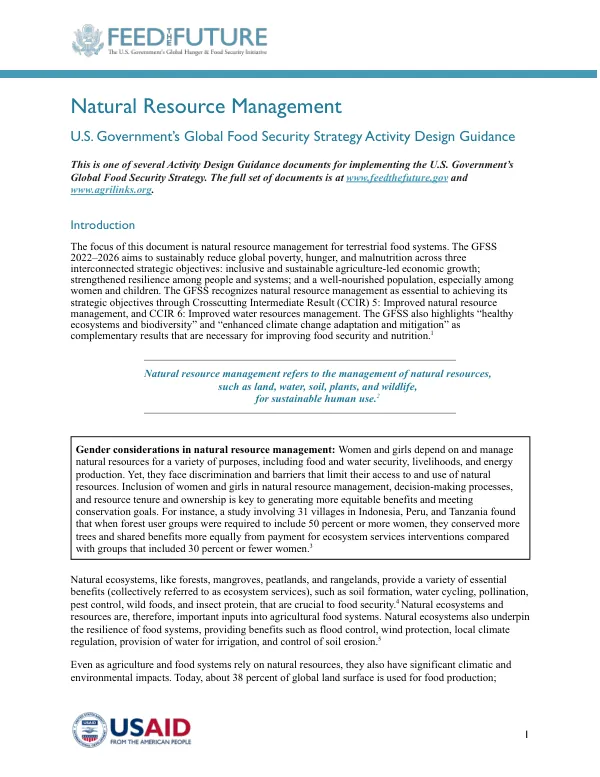
Government's Global Food Security Strategy (GFSS) 2022-2026. The GFSS aims to sustainably reduce global poverty, hunger, and malnutrition through three interconnected strategic objectives: inclusive and sustainable agriculture-led economic growth, strengthened resilience among people and systems, and a well-nourished population, especially among women and children. Natural resource management is essential to achieving the GFSS's strategic objectives through Crosscutting Intermediate Result (CCIR) 5: Improved natural resource management, and CCIR 6: Improved water resources management. The GFSS also highlights "healthy ecosystems and biodiversity" and "enhanced climate change adaptation and mitigation" as complementary results necessary for improving food security and nutrition. Natural resource management refers to the management of natural resources, such as land, water, soil, plants, and wildlife, for sustainable human use. Women and girls depend on and manage natural resources for various purposes, including food and water security, livelihoods, and energy production. However, they face discrimination and barriers that limit their access to and use of natural resources. Inclusion of women and girls in natural resource management, decision-making processes, and resource tenure and ownership is key to generating more equitable benefits and meeting conservation goals. For instance, a study involving 31 villages in Indonesia, Peru, and Tanzania found that when forest user groups were required to include 50 percent or more women, they conserved more trees and shared benefits more equally from payment for ecosystem services interventions compared with groups that included 30 percent or fewer women. Natural ecosystems, such as forests, mangroves, peatlands, and rangelands, provide essential benefits, including soil formation, water cycling, pollination, pest control, wild foods, and insect protein, that are crucial to food security. Natural ecosystems and resources are important inputs into agricultural food systems and underpin the resilience of food systems, providing benefits such as flood control, wind protection, local climate regulation, provision of water for irrigation, and control of soil erosion. However, agriculture and food systems have significant climatic and environmental impacts. Approximately 38 percent of the global land surface is used for food production, with two-thirds used for grazing livestock and a third for cropland. Food systems account for 34 percent of global greenhouse gas (GHG) emissions, and are a key driver of habitat and biodiversity loss due to land conversion. Unsustainable agricultural and natural resource management practices, particularly those that result in deforestation, pollution, overfishing, and overgrazing of rangelands, threaten the food security, nutrition, and livelihoods of millions of people. Implementation of sustainable agricultural production practices, such as conservation agriculture, crop rotation, integration of perennials and agroforestry, and water resource management, are crucial to improving productivity as well as the condition of natural resources and conserving ecosystem services. These practices also have climate adaptation, climate mitigation, and agricultural profitability co-benefits. Interventions across agricultural production and market systems, including improved land use planning and land and water resource governance, can foster sustainable natural resource use and support improved natural resource management at the landscape and farm/plot levels. Promoting clear, transparent, and secure land and resource rights and tenure can incentivize sustainable improvements in agricultural productivity and natural resource management, promote gender equality and women's economic empowerment, promote stability and prevent conflict, support livelihoods, and enable on- and off-farm investment. Improved natural resource management is a critical foundation for sustainable food systems that can meet future needs, particularly for smallholder farmers who are highly dependent on the ecosystem service benefits provided by natural resources.