USAID DEC
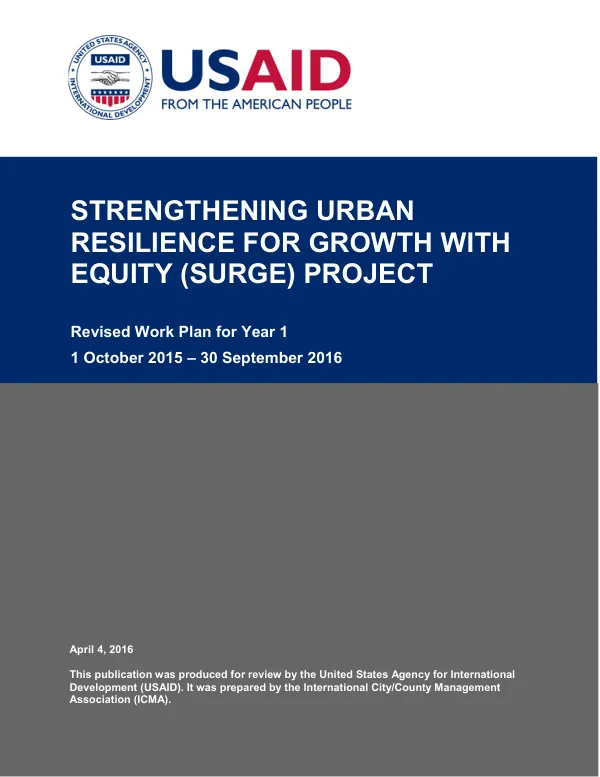
Revised Work Plan for Year 1 of the Strengthening Urban Resilience for Growth with Equity (SURGE) Project
Sign inINTERNATIONAL CITY AND COUNTY MANAGEMENT ASSOCIATION
Revised Work Plan for Year 1 of the Strengthening Urban Resilience for Growth with Equity (SURGE) Project
The SURGE project is a USAID-funded initiative aimed at strengthening urban resilience for growth with equity in the Philippines.
2016 · 69 pages
Sign in to readA free account is required to download.
Abstract
The project began in 2015 and is scheduled to run until 2016. The project's primary objective is to improve the resilience of urban areas in the Philippines by enhancing their capacity to withstand and recover from natural disasters and economic shocks. The SURGE project is divided into four components: Component 1 focuses on improving local capacity in inclusive and resilient urban development, Component 2 promotes low-emission local economic development strategies, Component 3 expands economic connectivity and access between urban and rural areas, and Cross-Cutting Areas address issues such as gender, communication, and monitoring and evaluation. Component 1 aims to improve local capacity by providing training and technical assistance to local government units (LGUs) in the Philippines. The component focuses on developing the capacity of LGUs to plan, implement, and manage urban development projects. This includes providing training on urban planning, infrastructure development, and disaster risk reduction. Component 2 focuses on promoting low-emission local economic development strategies. The component aims to reduce greenhouse gas emissions in urban areas by promoting sustainable economic development practices. This includes providing technical assistance to LGUs to develop low-emission economic development plans and strategies. Component 3 expands economic connectivity and access between urban and rural areas. The component aims to improve the economic connectivity between urban and rural areas by promoting trade and investment between the two areas. This includes providing technical assistance to LGUs to develop trade and investment plans and strategies. Cross-Cutting Areas address issues such as gender, communication, and monitoring and evaluation. The component focuses on ensuring that the project's activities are inclusive and equitable, particularly for women and other marginalized groups. This includes developing a gender action plan to ensure that the project's activities are gender-sensitive and inclusive. The project's estimated budget for Year 1 activities is approximately $1.5 million. The budget is allocated across the four components, with Component 1 receiving the largest share of the budget. The project's implementation is expected to be completed by September 2016. The SURGE project is expected to have a significant impact on the resilience of urban areas in the Philippines. The project's activities are expected to improve the capacity of LGUs to plan, implement, and manage urban development projects, reduce greenhouse gas emissions, and improve economic connectivity between urban and rural areas. The project's impact is expected to be felt in the short-term, with improvements in urban resilience and economic development expected to be seen within the first two years of the project's implementation. The project's success will depend on the effective implementation of its activities and the level of support provided by the project's stakeholders, including the Philippine government and local government units. The project's monitoring and evaluation framework will be used to track its progress and identify areas for improvement. The SURGE project is a critical initiative aimed at strengthening urban resilience for growth with equity in the Philippines. The project's activities are expected to have a significant impact on the resilience of urban areas in the Philippines and contribute to the country's economic development.