USAID DEC
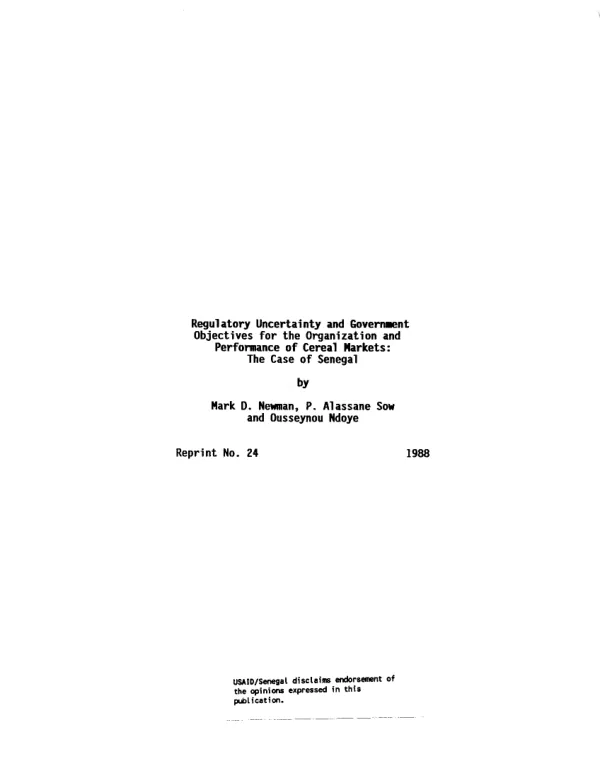
Rice marketing in the Senegal River Valley : research findings and policy reform options
Sign inMICHIGAN STATE UNIVERSITY. DEPT. OF AGRICULTURAL ECONOMICS
Rice marketing in the Senegal River Valley : research findings and policy reform options
If the ambitious plan of the Governments of Senegal, Mali, and Mauritania to develop the Senegal River valley (Fleuve region) succeeds, irrigated rice production will increase by some 240,000 ha in Senegal alone, raising the question of whether Senegal"s rice marketing policies are flexible enough to handle such an increase in production.
Morris, Michael L. · 1970
Sign in to readA free account is required to download.
Abstract
This paper (1) presents the results of the Fleuve Cereals Marketing Study, which examined the organization and performance of area rice markets, and (2) explores policy reform options to improve future performance. A key element in the Fleuve market structure is the existence of a thriving, but illegal, parallel market, which is more responsive to changes in demand than is the official marketing channel (a network of government agencies, parastatals, and licensed private traders), which has proven inefficient, costly, and prone to corruption, while at the same time serving real economic needs, e.g., by guaranteeing a market outlet for producers and by stabilizing prices. Policy reform should focus on making public markets more responsive to demand through, in part, the integration of indigenous traders. Policy reform options are analyzed for market organization and licencing requirements, prices and pricing mechanisms, the role of public-sector marketing organizations, and rice processing techniques. Barriers to conducting successful policy reform are discussed in the final section, as are methods for eliminating them.
Connected topics
Related documents