USAID DEC
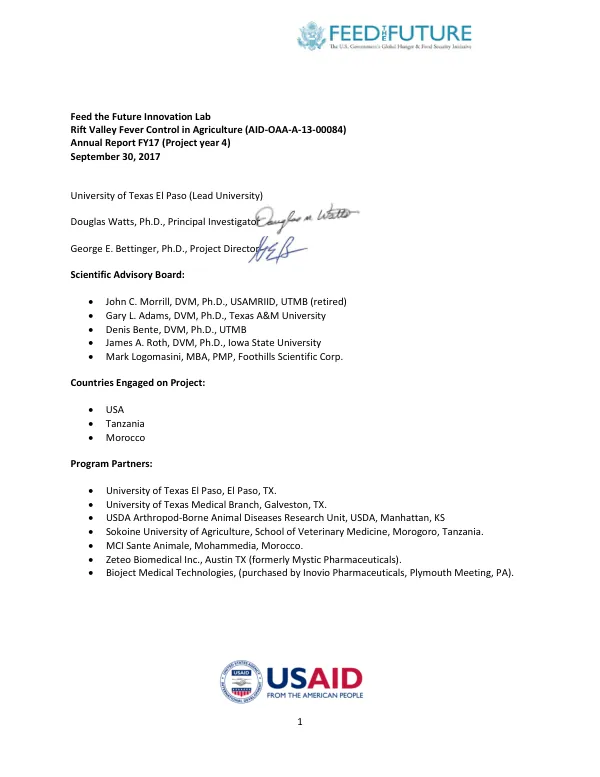
Rift Valley Fever Control in Agriculture (AID-OAA-A-13-00084) Annual Report FY17 (Project year 4)
Sign inHUAZHONG AGRICULTURAL UNIVERSITY
Rift Valley Fever Control in Agriculture (AID-OAA-A-13-00084) Annual Report FY17 (Project year 4)
The Rift Valley Fever Control in Agriculture project, funded by the US Agency for International Development (USAID), aimed to develop a live, attenuated vaccine to protect livestock against Rift Valley fever virus.
2017 · 19 pages
Sign in to readA free account is required to download.
Abstract
The project, led by the University of Texas El Paso, involved a multidisciplinary team of researchers from the US and Tanzania. The project's primary objective was to develop a vaccine that could be used in open field studies to protect livestock against Rift Valley fever virus. The project's Scientific Advisory Board, comprising experts in vaccine development and manufacturing, Rift Valley fever, and animal testing, reviewed the project's objectives and recommended shifting resources from molecular virology studies to increased animal testing. This decision was based on the Board's assessment that the vaccine virus, MP-12, had a low potential for reassorting genomes between related species, making it safe and effective for use in open field studies. The project made significant progress in developing the vaccine, including the creation of a new lot of Master Virus Seed (MVS) made by MCI Sante Animale, Morocco. The MVS was tested and found to be identical to the intended virus by RNA sequence and its interaction with antibody to RVFV. Additionally, the vaccine was screened and determined to be sterile and free of adventitious agents as required by USDA vaccine requirements. The project also made significant strides in animal testing, with vaccination studies initiated on Tanzanian-sourced livestock (goats, sheep, and calves) in the renovated ABSL-2 barn at Sokoine University of Agriculture (SUA). The facility was audited and found compliant with ABSL-2 requirements, and the animals have adequate space and adjust well to the pens. The project also trained three additional SUA students in molecular virology techniques, in addition to supporting three students in their PhD and MPhil projects. The project operated within budget and on schedule, with two women at UTMB receiving their degrees and one man at UTEP partially funded by the project in a Ph.D. program. At SUA, one woman was supported in a Ph.D. program and two women in the Master of Philosophy program. The project also made site visits to UTMB, Texas A&M University, the ARS/USDA Lab, and Kansas State University, and transferred a UTEP virologist to SUA to oversee the safe operation of the lab and provide daily instruction and guidance in laboratory techniques. The project's findings and accomplishments have significant implications for the development of a live, attenuated vaccine to protect livestock against Rift Valley fever virus. The results of the project's research and testing have improved the safety profile of the vaccine, making it a promising tool for controlling Rift Valley fever in livestock. The project's success has also contributed to SUA's receipt of 5-year funding as an African Center of Excellence for Infectious Disease.