FAMILY HEALTH INTERNATIONAL
USAID Global Health Supply Chain Program – Quality Assurance Annual Report – 2017
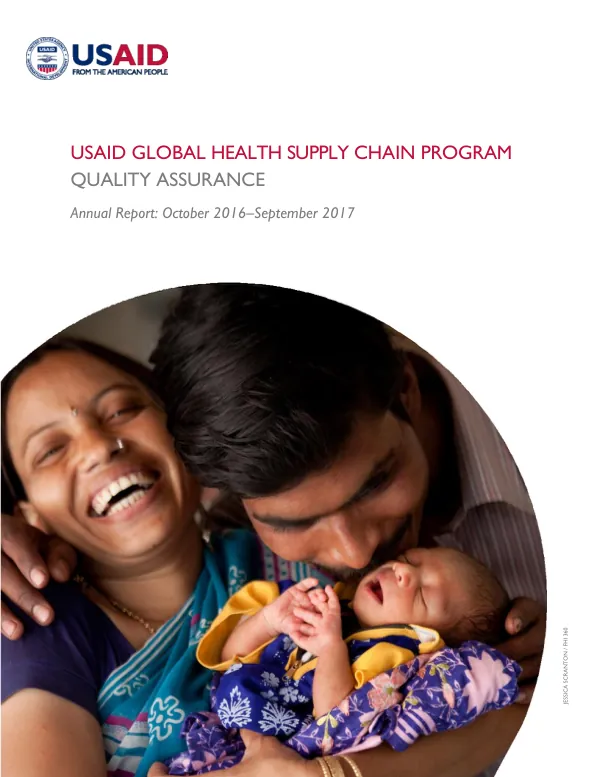
The Global Health Supply Chain-Quality Assurance Program (GHSC-QA) is a comprehensive risk-based quality assurance strategy that helps ensure vulnerable populations worldwide receive safe and effective pharmaceuticals, medical devices, and other health products.
2017 · 36 pages
Sign in to readA free account is required to download.
Abstract
In fiscal year 2017, GHSC-QA worked toward this goal across all four project objectives. Under Objective 1, Quality Assurance, GHSC-QA investigated 60 product quality incidents, completed prequalification technical evaluations/dossier reviews for 34 products, and completed risk assessments for 11 new products, including formulations for essential medicines such as ciprofloxacin, metronidazole, erythromycin, and cotrimoxazole. The technical advisory group (TAG) focused on family planning and pharmaceuticals and medical devices expanded its scope to include all product categories except rapid test kits (RTKs) and diagnostics. Two new members joined the TAG in response to its broader scope. GHSC-QA continued support of the Global Health Supply Chain's (GHSC) efforts to identify and source high-quality manufacturers and suppliers for essential health commodities. Program staff updated and published official lists of eligible products and suppliers for pharmaceuticals, voluntary medical male circumcision (VMMC) kits, food by prescription (FBP), and reproductive health (RH) products. In fiscal year 2017, program staff collaborated with USAID to create new eligible product lists for antiretroviral medicines (ARVs) and HIV RTKs, the first time such lists were published under GHSC-QA. Under Objective 2, Quality Control, the program tested and evaluated 2,484 lots of essential health commodities purchased on behalf of USAID, a 35% increase from project year 2. This ensured that safe and effective products were being provided to people across the globe. In the fourth quarter, a request for quotation (RFQ) was issued to re-compete testing services under GHSC-QA. The goal of the RFQ was to ensure best value for testing services, identify new vendors that offer strategic value to the program, and increase the overall capacity of testing services available for periods of high volume. The testing network was redesigned and expanded to allow for greater flexibility and bandwidth in sourcing options, while also including options for local testing laboratories in key countries. In addition to the laboratory testing RFQ, the program issued an RFQ for laboratory testing supplies, to ensure best prices for laboratory testing supplies and reagents used for testing conducted by FHI 360. Laboratory Network RFQ Summary indicates that 30 laboratories were contacted, 14 quotations were received, and 3 new laboratories were added, representing 10 countries. Under Objective 3, Technical Assistance, activities included both long-term, mission-funded TA initiatives in Cote d'Ivoire and Afghanistan, as well as capacity-building activities in Ethiopia, Ghana, Haiti, Nigeria, Tanzania, and Zambia. Key activities in Cote d'Ivoire included training for testing and procuring male condoms, participation in the 2017 GHSC-QA Male Condom Testing Proficiency Trial, laboratory equipment assessment and procurement recommendations, and establishment of a chemical waste disposal program. The program also initiated project start-up activities for delivering TA supporting the in Kabul, Afghanistan. Under Objective 4, Collaboration, GHSC-QA continued to strengthen its processes and communication with stakeholders, including the Global Health Supply Chain, USAID, and other partners. The program also convened the first TAG on HIV RTKs and instrument-based diagnostics, an important step in the long-term strategy for ensuring procurement of reliable RTKs under the GHSC Initiative.
Related documents