FHI360
Rights-Based Approach to Family Planning
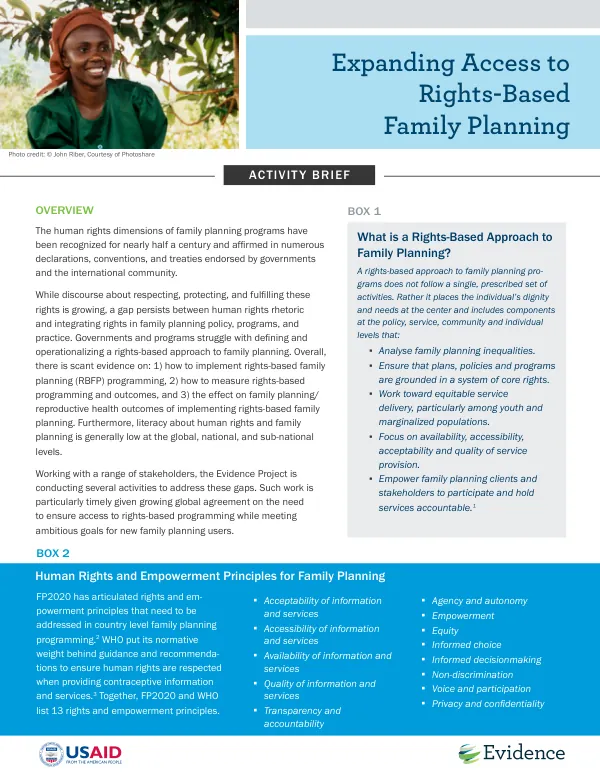
A rights-based approach to family planning places the individual's dignity and needs at the center, incorporating components at the policy, service, community, and individual levels.
2015 · 2 pages
Sign in to readA free account is required to download.
Abstract
This approach involves analyzing family planning inequalities, ensuring that plans, policies, and programs are grounded in a system of core rights, and working toward equitable service delivery, particularly among youth and marginalized populations. The human rights dimensions of family planning programs have been recognized for nearly half a century and affirmed in numerous declarations, conventions, and treaties endorsed by governments and the international community. However, a gap persists between human rights rhetoric and integrating rights in family planning policy, programs, and practice. Governments and programs struggle with defining and operationalizing a rights-based approach to family planning, and there is a lack of evidence on how to implement rights-based family planning programming, measure rights-based programming and outcomes, and the effect on family planning/reproductive health outcomes of implementing rights-based family planning. The Evidence Project is conducting several activities to address these gaps, including synthesizing key frameworks, tools, and principles documents to help implementers operationalize rights-based family planning. The project has also developed a resource, "Rights-based Family Planning: 10 Resources to Guide Programming," which pulls together resources for putting into action a rights-based approach to family planning. Additionally, the Evidence Project is collaborating with global partners to consistently define rights-based family planning programming through participation in working groups and meetings. Incorporating and operationalizing rights-based approaches in costed implementation plans is also a key focus of the Evidence Project. The project is working with the Ministry of Health and Reproductive Health Uganda to develop an action plan for a rights-based approach in support of the country's Family Planning Costed Implementation Plan (FP CIP). This work is helping implementers think through what they should be doing differently in their programming by taking a rights-based approach at the policy, service, community, and individual levels. The Evidence Project is also testing an index to measure adherence to rights-based family planning principles at the service delivery level. This study is measuring individual facilities' level of integration and implementation of rights-based family planning, including identifying rights vulnerabilities that can be addressed through small-scale service delivery modifications. The project has also produced an easy-to-use table of potential rights indicators proposed by various international groups, including FP2020, WHO, and Performance, Monitoring and Accountability 2020. This resource is helping countries or organizations move from rights principles in planning documents to monitoring the effects of rights-based approaches to family planning.
Related documents