USAID DEC
Rigorous Outcome Performance Evaluations (ROPEs) in Democracy, Human Rights, and Governance
Sign inUSAID
Rigorous Outcome Performance Evaluations (ROPEs) in Democracy, Human Rights, and Governance
Rigorous Outcome Performance Evaluations (ROPEs) in Democracy, Human Rights, and Governance aim to address the limitations of traditional impact evaluations (IEs) and basic performance evaluations (PEs).
2024 · 7 pages
Sign in to readA free account is required to download.
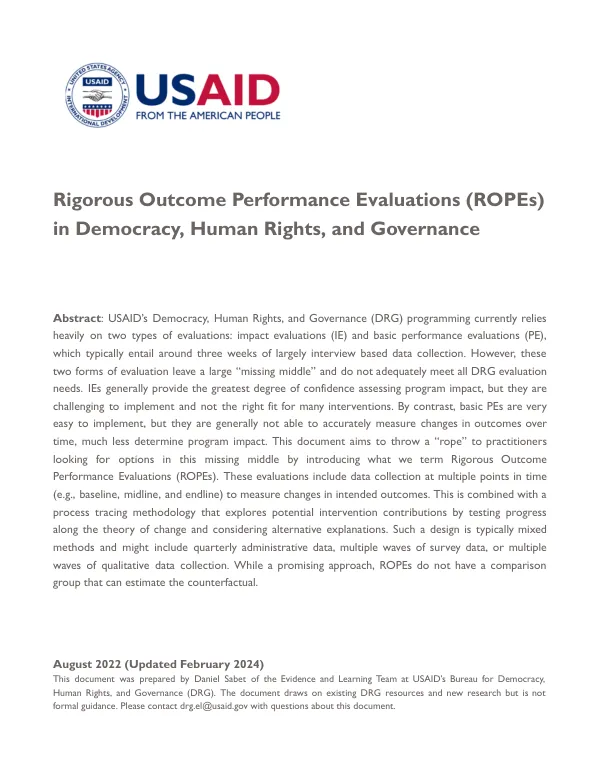
Abstract
These evaluations typically involve a one-time study with three to four weeks of qualitative field work, which can struggle to measure outcomes and changes in outcomes over time. ROPEs, on the other hand, are longitudinal designs that measure outcomes at multiple points in time, combined with a process tracing methodology. This approach offers several advantages over basic PEs, including the ability to measure changes in outcomes over time with greater confidence, inform interventions prior to a summative endline evaluation, and consider possible intervention contributions by exploring progress along the theory of change and alternative explanations for changes in outcomes. One of the key benefits of ROPEs is their ability to provide more accurate measures of changes in intended outcomes over time. This is particularly important in DRG work, where reforms may be implemented but not necessarily lead to meaningful change. By conducting multiple waves of data collection, evaluators can improve their measurement accuracy and confidence in their conclusions. ROPEs can be used in a variety of situations, including when an IE is not the right fit for an intervention, when outcomes are not likely to improve on their own, and when it is difficult to determine USAID's contribution to observed changes. Examples of ROPEs include evaluations of juvenile justice reform in Guyana, St. Lucia, and St. Kitts and Nevis, reform of the electrical utility in Malawi, and procurement reform in Honduras. These evaluations used a mixed-methods approach, combining qualitative data with administrative and survey data. They were able to confidently document changes or lack of change over time, consider the influence of alternative factors, understand and document obstacles along the theory of change, make reasonable conclusions about the performance of the intervention, and make recommendations to inform the intervention. Despite their benefits, ROPEs are not without challenges. One of the main limitations is the difficulty in assigning attribution to an intervention, as other factors that vary over time may offer better explanations for observed changes. Additionally, implementing a ROPE can be complex and time-consuming, requiring significant resources and expertise. To address these challenges, evaluators can use a variety of methods, including statistical control and qualitative methods to eliminate alternative explanations. Process tracing, in particular, is a useful approach for evaluating many USAID interventions, as it builds off a program's theory of change and considers alternative explanations for changes in outcomes. In conclusion, ROPEs offer a promising approach for evaluating DRG interventions, providing a more accurate measure of changes in intended outcomes over time and considering possible intervention contributions. While they are not without challenges, ROPEs can be a valuable tool for evaluators and practitioners looking to improve the effectiveness of their interventions.