CARE
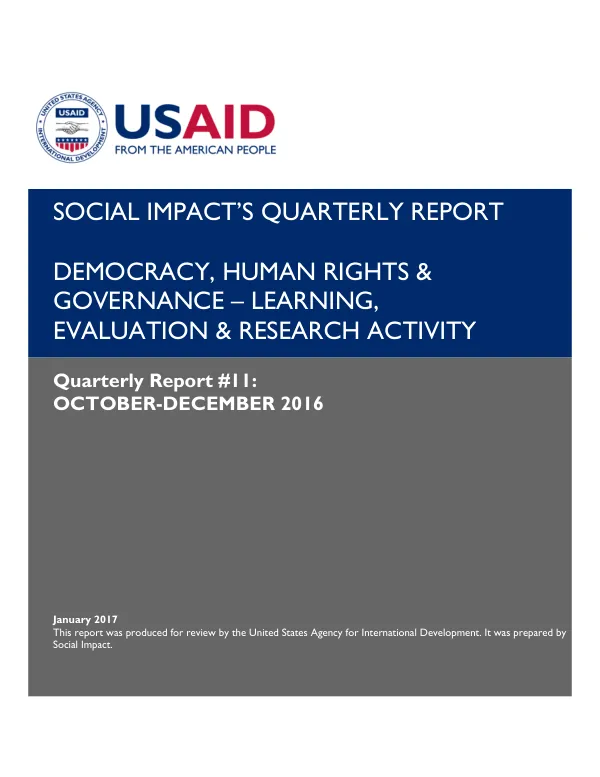
Quarterly Report #8: October-December 2015
The Democracy, Human Rights and Governance – Learning, Evaluation and Research Activity (DRG-LER) task order, funded by the United States Agency for International Development (USAID), is a quarterly report summarizing activities conducted by Social Impact (SI) during the period of October-December 2015.
2015 · 7 pages
Sign in to readA free account is required to download.
Abstract
The report describes the status of all tasking requests received to date under the DRG-LER task order. Significant milestones reached this quarter include the completion of impact evaluation baseline data collection and reporting in South Africa, the conclusion of the Mozambique impact evaluation activity with the presentation of final findings, and the completion of draft final reports for the Ukraine and Libya performance evaluations. Accomplishments include receiving positive feedback from South Africa government stakeholders on the utility of the impact evaluation baseline report and the Uganda impact evaluation research team sharing lessons learned to date to inform USAID and implementing partner workplan discussions on scaling up related activities. The report highlights several ongoing impact evaluations, including the Ghana Strengthening Accountability Mechanisms (G-SAM) evaluation, which explores the impact of two local governance interventions on the accountability of district officials. In this quarter, SI posted the approved baseline report to the Development Experience Clearinghouse (DEC) and engaged a local researcher to attend implementing partner coordination meetings in Accra. Another ongoing evaluation is the South Africa Increasing Services for Survivors of Sexual Assault impact evaluation, which tests two different approaches to increasing utilization of Thuthuzela Care Centers (TCCs). In this quarter, SI submitted the baseline report to USAID, the implementing partners, and the National Prosecuting Authority (NPA) that administers the TCCs, and completed endline data collection. The report also highlights the Mozambique Voter Education and Political Accountability impact study, which examined the effect of different information delivery mechanisms on political participation in Mozambique. In Q2, SI completed a methods and findings brief for this evaluation, and DRG-LER Chief of Party, Daniel Sabet, presented findings at USAID in December. Additionally, the report mentions the Uganda SMS for better Service Provision impact evaluation, which tests the combined effectiveness of the U-Bridge platform and citizen outreach efforts on political accountability and the quality of service delivery in Arua district. In this quarter, SI began to prepare an alternative data collection methodology to replace the endline household survey, and the SI evaluation team prepared a memo for USAID/Uganda and GAPP implementers, which shared evaluation lessons learned to date to inform their decisions in deciding how to scale up the GAPP program. The report also highlights two scoping trips planned for the Eastern and Southern Caribbean region, one for the Youth community-level resilience activity and another for the Juvenile justice activity, both under the forthcoming five-year citizen security Youth Empowerment Systems (YES) Project. In this quarter, SI began recruiting Principal Investigators and planning scoping trips to the Caribbean to be conducted early in Q2. Furthermore, the report mentions the Macedonia Judicial Strengthening performance evaluation, which was conducted by SI. The evaluation aimed to assess the progress of the judicial reform process in Macedonia and provide recommendations for future improvements. Overall, the report provides an update on the progress of various impact evaluations and performance evaluations conducted by SI under the DRG-LER task order, highlighting significant milestones, accomplishments, and challenges faced during the quarter.