ICF
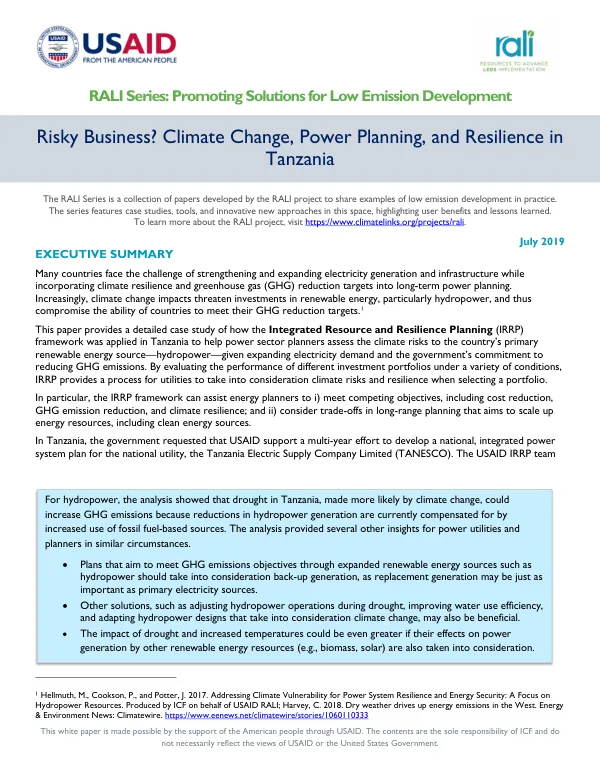
Risky Business? Climate Change, Power Planning, and Resilience in Tanzania
In Tanzania, the government requested that USAID support a multi-year effort to develop a national, integrated power system plan for the national utility, the Tanzania Electric Supply Company Limited (TANESCO).
2019 · 11 pages
Sign in to readA free account is required to download.
Abstract
The USAID IRRP team worked with TANESCO to identify several plausible investment portfolios and then tested their performance in meeting several objectives across a broad range of potential futures. After considering the trade-offs, including those related to hydropower expansion, TANESCO selected the "best" performing investment portfolio to serve as a roadmap to guide future investment planning decisions. Hydropower can serve as a key component of low emission development strategies (LEDS), enabling countries to enhance energy security while also furthering their ability to reduce GHG emissions and meet their Nationally Determined Contributions (NDCs). Currently, hydropower makes up two-thirds of global renewable electricity generation and is growing rapidly; capacity increased nearly 22 GW in 2017. Additionally, $48 billion of investment was committed to hydropower projects in 2017—nearly double that of 2016—indicating strong future growth. The Integrated Resource and Resilience Planning (IRRP) framework enables power providers to assess the performance trade-offs of different investment plans against a range of criteria—such as cost, reliability, and GHG reduction goals—across a range of potential future scenarios, including scenarios reflecting climate change impacts. IRRP is a method for developing a power system investment plan that is more resilient to various risks, including climate change. It builds on a traditional planning approach in the energy sector—integrated resources planning—by explicitly addressing risks and resiliency concerns associated with key uncertainties, including potential impacts from a changing climate and other disruptive events. The IRRP process in Tanzania included the development of several plausible investment portfolios through consideration of existing plans, government commitments, stakeholder consultations, and financial and timing considerations. A scenario analysis was conducted to determine how the portfolios perform under various potential future scenarios. The performance of the portfolios was evaluated against a select set of metrics under the baseline and drought scenarios. The resulting "least-regrets" plan is more resilient than a least-cost plan, as it is robust and resilient under a range of possible futures that reflect inherent risks and uncertainties.
![Measurement Approaches for Effective Coverage Estimation [MR31]](https://covers.devme.ai/gen/138167.webp)