USAID
Many Heavens, One Earth: African Faith Commitments for a Living Planet
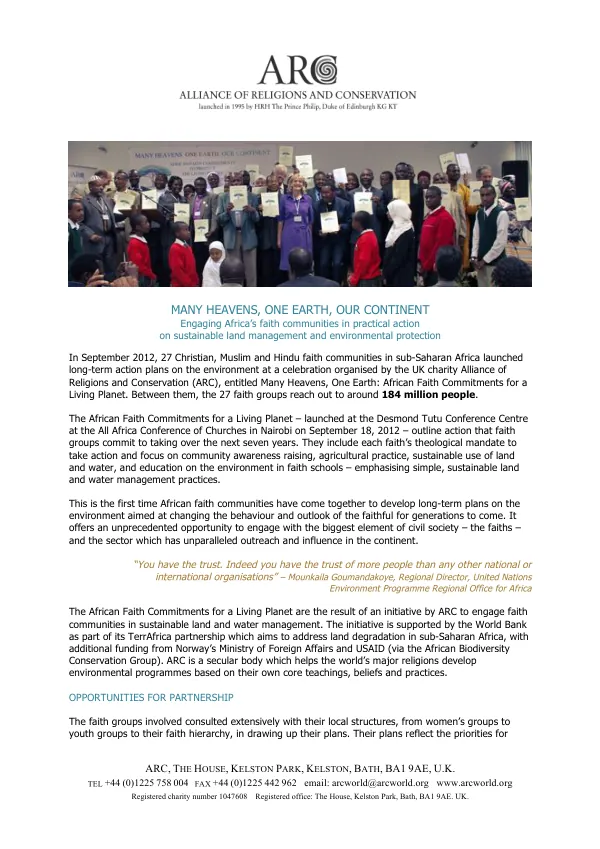
The African Faith Commitments for a Living Planet were launched in September 2012 by the Alliance of Religions and Conservation (ARC) in collaboration with 27 Christian, Muslim, and Hindu faith communities in sub-Saharan Africa.
2012 · 7 pages
Sign in to readA free account is required to download.
Abstract
These faith groups reach out to approximately 184 million people and have developed long-term action plans on the environment for the next seven years. The commitments outline action that faith groups commit to taking, including community awareness raising, agricultural practice, sustainable use of land and water, and education on the environment in faith schools. Each faith's theological mandate to take action is emphasized, with a focus on simple, sustainable land and water management practices. This initiative offers an unprecedented opportunity to engage with the biggest element of civil society - the faiths - and the sector which has unparalleled outreach and influence in the continent. The faith groups involved consulted extensively with their local structures, from women's groups to youth groups to their faith hierarchy, in drawing up their plans. Their plans reflect the priorities for action identified by their communities and are broadly clustered in five key themes. These themes offer opportunities for partnership with secular and government organizations. One of the key themes is Changing Hearts and Minds, which focuses on behavior change and awareness raising in faith communities. Examples of planned faith action include the Ethiopian Islamic Affairs Supreme Council's plan to organize national-level training in environmental protection for 100 Muslim leaders, and the Catholic bishops in Kenya's plan to launch an annual Catholic Environment Day with each Catholic to plant at least one tree. Another key theme is Leading by Example, which focuses on developing faith institutions as centers of environmental good practice. Examples of planned faith action include the Ethiopian Orthodox Church's proposal to create a learning center in each monastery for improved technology demonstration and dissemination of such technology to the local community, and the Ethiopian Islamic Affairs Supreme Council's proposal to set up model eco mosques to demonstrate tree care and planting, agroforestry methods, and conservation agriculture. A third key theme is Shaping the Future, which focuses on engaging young people through the faiths' existing extensive role in formal education and informal outreach. Examples of planned faith action include the Uganda Muslim Women Association's plan to set up a model farm for demonstrating tree planting, agroforestry, and sustainable agriculture, and the Green Top Project of the Uganda Muslim Youth Assembly and Humanitarian Efforts and Relief Uganda's plan to target 50 schools, 50 mosques, and 50 households to demonstrate water conservation through rainwater harvesting and create a model farm to teach water and soil preservation techniques. The African Faith Commitments for a Living Planet have been supported by the World Bank as part of its TerrAfrica partnership, which aims to address land degradation in sub-Saharan Africa, with additional funding from Norway's Ministry of Foreign Affairs and USAID (via the African Biodiversity Conservation Group). The commitments offer an unprecedented opportunity to engage with the biggest element of civil society - the faiths - and the sector which has unparalleled outreach and influence in the continent.
Related documents