USAID DEC
Role of Social Support in Improving Infant Feeding Practices in Western Kenya: A Quasi-Experimental Study
Sign inJOHNS HOPKINS UNIVERSITY BLOOMBERG SCHOOL OF PUBLIC HEALTH/INFO PROJECT
Role of Social Support in Improving Infant Feeding Practices in Western Kenya: A Quasi-Experimental Study
Malnutrition is a contributing factor in 45% of under-5 child deaths.
2016 · 18 pages
Sign in to readA free account is required to download.
Abstract
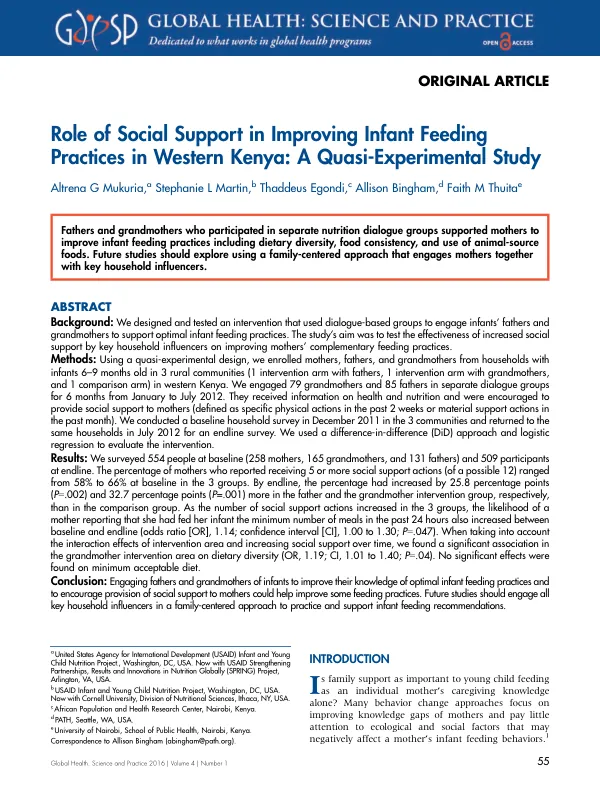
In developing countries, more than 3.5 million children under 5 years of age die each year with undernutrition as an underlying cause. Optimal infant and young child feeding (IYCF) practices contribute greatly to child nutrition. Such optimal practices include exclusive breastfeeding for 6 months and appropriate complementary feeding from 6 months through at least 2 years of age. In Kenya, high rates of childhood malnutrition began to gradually fall between 2009 and 2014. Stunting decreased from 35% to 26%, and wasting from 7% to 4%. Nevertheless, Kenya is one of the 36 countries that carries 90% of the global burden of stunting. Contributing to Kenya's high rates of malnutrition are poor IYCF practices. The 2008-09 Demographic and Health Survey (DHS) found that in western Kenya, only 71% of children aged 6 to 23 months were fed the recommended minimum number of times for their age and breastfeeding status, and about 50% of young children were fed adequately diverse diets. The influence of fathers and grandmothers on IYCF practices is well documented in the literature. Our formative research found that caregivers, fathers, and grandmothers typically lack up-to-date knowledge of optimal IYCF practices, particularly during the complementary feeding period. Employing a socioecological model, we used peer support groups to engage grandmothers and fathers in rural Kenya to support optimal infant feeding practices. We conducted a multi-phased, multi-method study between June 2010 and July 2012, which included qualitative formative research to understand nutrition knowledge and practices, social and cultural relations in the community, health and nutrition-related roles and responsibilities in households, and social support. This formative research informed questionnaire development and intervention design. We also conducted a quantitative baseline survey on nutrition knowledge, practices, and social support, as well as community-based interventions, including dialogue groups with fathers and grandmothers, community mobilization, and a process evaluation.
Related documents
Documents in this collection
 2017
2017USAID DEC
MCSP Nutrition Brief: Addressing Barriers to Exclusive Breastfeeding: Evidence and Program Considerations for Low- and Middle-Income Countries
Open record 2019
2019USAID DEC