TETRA TECH DPK
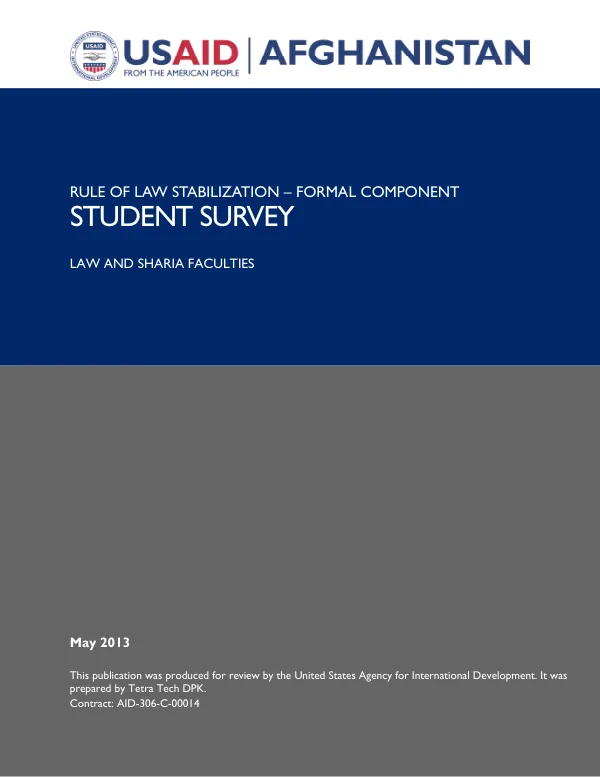
Rule of Law Stabilization – Formal Component Student Survey
The Rule of Law Stabilization – Formal Component (RLS-Formal) is a United States Agency for International Development (USAID) funded program designed to increase public confidence in the rule of law system and support the improved performance and accountability of governance in Afghanistan.
2013 · 31 pages
Sign in to readA free account is required to download.
Abstract
The program aims to increase the quality and availability of legal education in Afghanistan by providing technical assistance to Law and Sharia faculties. RLS-Formal conducted a student survey in May 2013 to assess the impact of the program on legal education in Afghanistan. The survey was conducted at eight universities in Afghanistan, including Kabul, Nangahar, Balkh, Herat, Al Biruni, Khost, Kunduz, and Takhar. A total of 394 students were randomly selected and interviewed face-to-face using standardized questionnaires. The survey aimed to measure the achievement of objectives assigned to the project in its contract and through the USAID/Afghanistan Performance Management Plan (PMP) for 2011-2015. The survey results affirm that USAID and RLS-Formal are taking the right approach to legal education in Afghanistan. The results show that a student is more likely to agree that USAID's objective for legal education is being achieved if they are enrolled in a Law and Sharia faculty impacted by RLS-Formal's programs or have participated in a practical legal educational activity. Specifically, the survey found that a student enrolled in a Law and Sharia faculty impacted by RLS-Formal is 138 percent more likely to say that the availability of quality legal education expanded. The survey also highlights the opportunities and challenges facing female students at Law and Sharia faculties. The results show that over 90 percent of students participating in practical legal coursework express increased confidence in their ability to enter the justice sector. This constitutes the result for an outcome-level performance indicator from RLS-Formal's Performance Management Plan. RLS-Formal's assistance to universities includes providing technical assistance to support critical thinking and legal analysis as part of the core curriculum. The program also provides support for scholarships and study abroad programs, and modernizes teaching methodologies. The objective of USAID and RLS-Formal's work in legal education is to expand the availability of quality legal education in Afghanistan, which is explicitly stated in USAID/Afghanistan's PMP for 2011-2015 and in RLS-Formal's contract. The survey results also show that legal clinics and other practical legal educational activities are key aspects of RLS-Formal's approach to legal education. The program has supported the completion of legal clinics, moot court competitions, and legal research and writing courses by over 1,160 students. Additionally, the program has provided refurbished law libraries, computer labs, and research centers to 17 faculties of Law and Sharia, and has developed 18 new legal courses or curricula with the project's assistance. Overall, the survey results affirm that RLS-Formal is making progress in achieving its objectives in legal education in Afghanistan. The program's approach to providing technical assistance and support for practical legal educational activities is showing positive results, and the survey highlights the opportunities and challenges facing female students at Law and Sharia faculties.
Related documents