DEVELOPMENT AND TRAINING SERVICES, INC.
USAID LAND REFORM IN AFGHANISTAN (LARA): FINAL REPORT
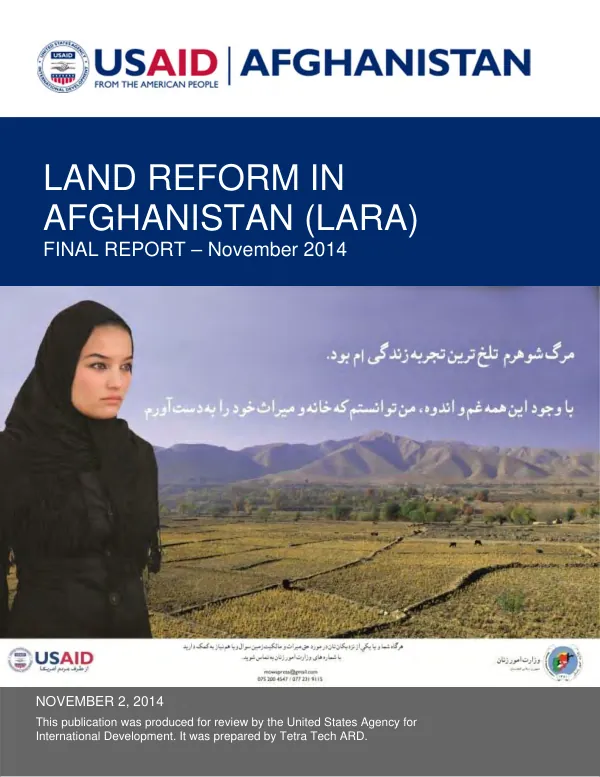
The Land Reform in Afghanistan (LARA) project began in January 2011 with a primary objective of strengthening land tenure security through formalization and upgrading of informal settlements.
2014 · 102 pages
Sign in to readA free account is required to download.
Abstract
The project was implemented by Tetra Tech ARD under USAID Contract No. 306-C-00-11-00514-00, with assistance from partners Tetra Tech DPK, International Land Systems, Development & Training Services, Inc., and Landesa. The project's primary government partners included Arazi, the Ministry of Urban Development Affairs (MUDA), the Independent Directorate of Local Governance (IDLG), and the Afghan Geodesy and Cartography Head Office (AGCHO), as well as the Supreme Court and the Municipality of Jalalabad. The project's implementation spanned two 18-month periods, a "Base Period" and an "Option Period." The project focused on three main components: Component 1, Component 2, and Component 3. Component 1 aimed to strengthen land tenure security through formalization and upgrading of informal settlements. This component included activities such as upgrading informal settlements, urban planning, deeds registration, formalization of land/occupancy rights supported by cadastal mapping, and community participation. Component 2 focused on the legal framework, including activities such as legal framework development, regulations, and gender-related initiatives. Component 3 focused on capacity building, including institutional and private sector strengthening, IT system needs for counterparts, and training. The project's impact was significant, with notable successes in strengthening land tenure security, improving the legal framework, and enhancing capacity building. The project's success stories highlighted the importance of community participation, institutional strengthening, and IT system development in achieving project objectives. The project's performance monitoring report provided a comprehensive overview of project progress, highlighting achievements and challenges. The training summaries provided a detailed account of training activities conducted throughout the project, while the financials section provided a breakdown of project expenditures. The project's geographic focus was Afghanistan, with a specific emphasis on urban areas. The project's timeframes spanned from January 2011 to November 2014, with a no-cost extension period from 2014 to 2015. The project's recommendations and lessons learned highlighted the importance of continued support for land reform initiatives in Afghanistan. The project's success was attributed to the collaborative efforts of the project team, government partners, and other stakeholders. The project's impact was significant, with notable improvements in land tenure security, the legal framework, and capacity building. The project's success stories and lessons learned provided valuable insights for future land reform initiatives in Afghanistan.