TETRA TECH DPK
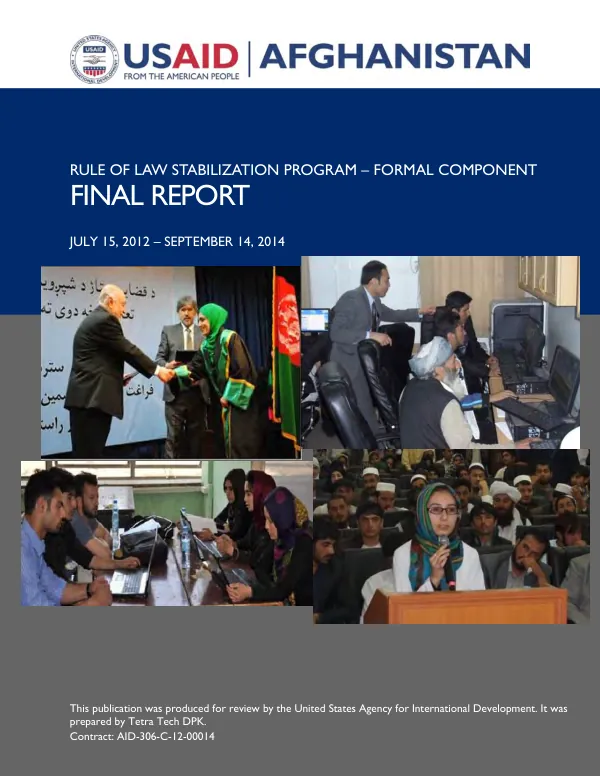
Rule of Law Stabilization Program – Formal Component Final Report
The Afghanistan Rule of Law Stabilization Program – Formal Component (RLS-Formal) was a United States Agency for International Development (USAID) funded project designed to increase public confidence in Afghanistan's justice sector and support the improved performance and accountability of governance.
2014 · 64 pages
Sign in to readA free account is required to download.
Abstract
The project aimed to achieve sustainable reforms in the formal justice sector in Afghanistan. RLS-Formal worked closely with the Supreme Court, the Ministry of Justice, and the Ministry of Higher Education to achieve its objectives. One of the significant achievements of the project was the transformation of the Judicial Education Department into a self-sustaining institution with the capacity to implement and oversee all legal education programs for current and future judges. The project provided instructor training and curriculum development at the Judicial Stage program to improve teaching methodologies, ensuring that Afghanistan's newest judges are prepared for service in the judiciary. The project also provided targeted trainings and technical assistance for judges from all Anti-Corruption Tribunals, and Continuing Legal Education trainings for sitting judges in all 34 provinces using a standardized curriculum. Additionally, RLS-Formal professionalized court administration through the Administrative Stage program, the new training program for clerks. The project developed databases to report case statistics and manage Supreme Court assets, and built the capacity of Supreme Court staff to lead trainings on each database, as well as the Afghanistan Court Administration System. These reforms effectively and sustainably increased the efficiency and transparency of the Supreme Court and all provincial courts nationwide, thereby improving the processes for resolving cases and, in turn, the public's perception of the formal justice system. RLS-Formal also collaborated with the Supreme Court to expand the Afghan Women Judges Association and transform the institution into a self-governing, fully functioning institution capable of administering programs that help Afghan women take more prominent roles in the justice sector. In close coordination with the Ministry of Higher Education, RLS-Formal enhanced and expanded legal education by developing the capacity of universities to administer legal clinics that use a standardized syllabus and successfully compete in national and international moot court competitions. The project also assisted the Ministry of Higher Education in implementing a unified core curriculum for all Sharia faculties and a credit hour system in all Law and Sharia faculties. In close coordination with the Ministry of Justice, RLS-Formal built the capacity of the Ministry of Justice to train regional staff on conducting public legal outreach campaigns and implementing the National Legal Awareness Strategy. The project also helped the Ministry of Justice cultivate a cadre of professionals that are able to create vibrant legal awareness campaigns that engage the public. From July 2012 through September 2014, RLS-Formal successfully partnered with the Supreme Court, the Ministry of Justice, and the Ministry of Higher Education to achieve sustainable reforms in the formal justice sector in Afghanistan. The project's achievements demonstrate its commitment to improving the performance and accountability of governance in Afghanistan, and its efforts to increase public confidence in the justice sector.