CHECCHI AND COMPANY, CONSULTING, INC.
Rule of Law Stabilization Program – Informal Component: Monthly Report, April 2013
The Rule of Law Stabilization Program – Informal Component (RLS-I) aims to enhance the rule of law in Afghanistan by developing a transparent, accountable, and gender-sensitive informal justice system.
2013 · 24 pages
Sign in to readA free account is required to download.
Abstract
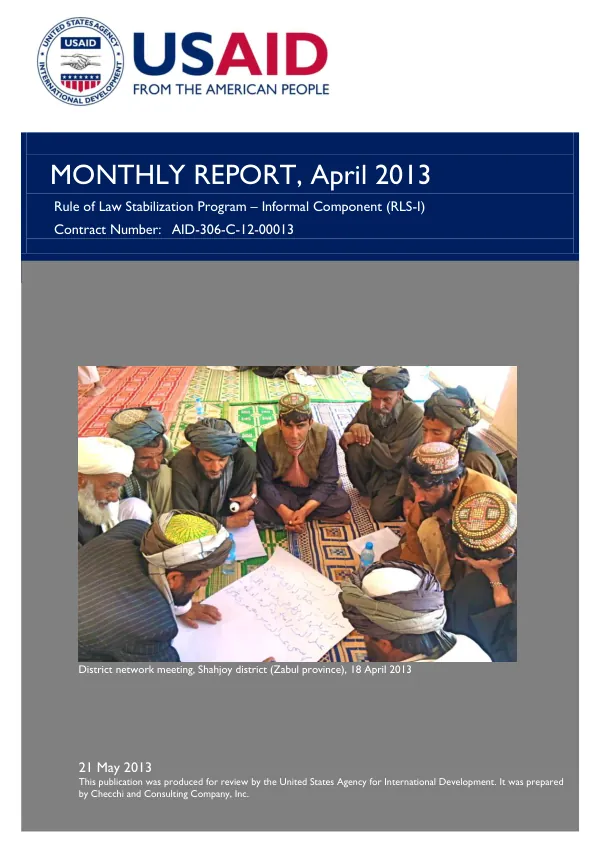
The program focuses on strengthening traditional dispute resolution, promoting stability within communities, and closing gaps that insurgents may exploit to acquire local legitimacy and political power. RLS-I also advances women's rights by empowering women to bring their disputes before informal and formal justice systems, and by working to eradicate customary practices such as baad, child marriages, and the refusal to grant women's inheritance rights. RLS-I Phase 3 programming in April consisted of intensive core program activities in the first tranche of new Phase 3 districts. Network meetings were conducted to introduce RLS-I objectives to village elders who resolve local disputes and provide opportunities to share dispute resolution experiences and coordinate on resolving long-standing disputes. These meetings contributed to the achievement of USAID/Afghanistan's Democracy and Governance Assistance Objective (AO) I, Intermediate Result (IR) 1.1, and Sub-IR 1.1.4, as well as RLS-I Program Objectives 1 and 3.1. Learning workshops were also conducted to deliver critical knowledge on specific aspects of Afghan law, including Constitutional law, criminal law, family law, inheritance law, property law, and property deeds law. These workshops contributed to the achievement of AO 1, IR 1.1, Sub-IR 1.1.4, and RLS-I Program Objectives 1, 2, and 3. Discussion sessions provided a forum for formal-informal justice sector working groups to meet and discuss pressing issues facing the formal and informal justice sectors. Coordination meetings allowed working group members to build trust and establish common understandings of jurisdiction and other coordination issues between the formal and informal justice sectors. In addition to core program activities, RLS-I Phase 3 programming in April included maintenance activities to address gaps in graduation criteria and targets aimed at advancing the remaining RLS-I Phase 1 and Phase 2 districts toward graduation during May. RLS-I district graduation criteria require completion of a five- to six-month core program consisting of six core curriculum legal education workshop topics, four discussion sessions, and three state-TDR coordination meetings. The program also conducted research, outreach, and monitoring and evaluation activities, including event monitoring, performance data collection, and outreach monitoring. The program's objectives are to increase knowledge of Afghan law among informal justice providers, foster linkages between informal and formal justice sector actors and institutions, and support dialogue and cooperation for the resolution of long-standing disputes. The program's activities are designed to contribute to the achievement of USAID/Afghanistan's Democracy and Governance Assistance Objective (AO) I, Intermediate Result (IR) 1.1, and Sub-IR 1.1.4, as well as RLS-I Program Objectives 1, 2, and 3.