USAID DEC
Rule of Law Stabilization Program – Informal Component: Monthly Report, November 2013
Sign inCHECCHI AND COMPANY, CONSULTING, INC.
Rule of Law Stabilization Program – Informal Component: Monthly Report, November 2013
The Rule of Law Stabilization Program – Informal Component (RLS-I) aims to enhance access to fair, transparent, and accountable justice for men, women, and children in Afghanistan.
2013 · 29 pages
Sign in to readA free account is required to download.
Abstract
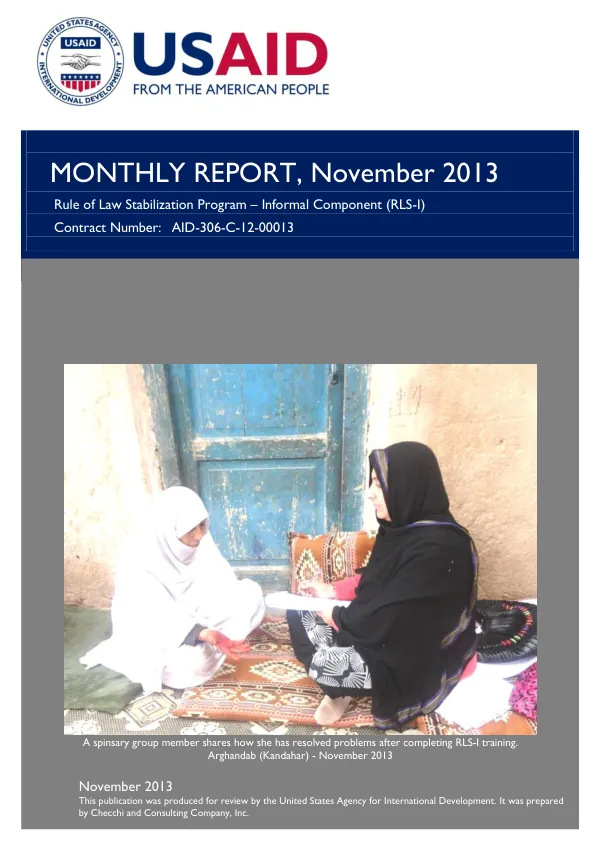
The program focuses on improving and strengthening the traditional dispute resolution system, bolstering collaboration between the informal and formal justice systems, and supporting cooperation for the resolution of longstanding disputes. RLS-I assesses the strengths and weaknesses of the local justice environment in each new district prior to commencing activities. The program engages a geographically and tribally representative group of approximately 250 respected male and female elders and other public and religious leaders in legal awareness and solutions-based programming. The 12-month district intervention consists of a six-month core program of coalition-building network meetings, legal education workshops, solutions-based discussion sessions, and formal-informal justice protocol coordination meetings. In November 2013, RLS-I continued core programming in 17 existing districts and conducted maintenance events in six districts. The program mentored subcontractors, The Liaison Office (TLO) and the Peace Training and Research Organization (PTRO), to implement core RLS-I programming in the North, specifically Baghlan, Takhar, and Badakhshan provinces. The RLS-I team in Jalalabad successfully completed a full set of legal awareness makeup activities for participants who missed the initial six core workshops. Public outreach efforts continued with RLS-I producing and airing radio/TV talk shows on Kandahar National Radio and Television (KNRT). The "Jirga and Justice" programs were being aired monthly through December 2013 with a new topic presented each month. In addition to the "Jirga and Justice" programs, RLS-I continued to broadcast previously produced radio talk shows and animated sketches on various topics, including alternatives to baad, inheritance and family rights, and the role of women in TDR. RLS-I also coordinated the production of a theatre play centered on the role of the jirga in resolving land seizure disputes. The theater production was performed in Zhari and Panjwayi districts (both in Kandahar). RLS-I also continued supporting PTRO and TLO with their respective outreach activities in the North. In November, M&E field staff monitored activities conducted in the East, South, and North (by subcontractors PTRO and TLO) and collected performance data. RLS-I's evaluation research partner, Strategic Social, delivered the final endline evaluation data. Security for RLS-I staff and participants remained an increasing concern due to the deteriorating security situation in advance of the Loya Jirga and the elections scheduled for April 2014. RLS-I Program Participation in the East Region included 58 events with 2,680 participants, consisting of 1,162 male participants and 1,518 female participants. The events included network meetings, workshops, discussion sessions, and coordination meetings. The RLS-I team in the East Region continued to engage with local stakeholders and implement core programming activities. RLS-I Program Participation in the South Region included 64 events with 2,499 participants, consisting of 1,627 male participants and 872 female participants. The events included network meetings, workshops, discussion sessions, and coordination meetings. The RLS-I team in the South Region continued to engage with local stakeholders and implement core programming activities. RLS-I Program Participation in the North Region included 50 events with 2,328 participants, consisting of 1,527 male participants and 801 female participants. The events included network meetings, workshops, discussion sessions, and coordination meetings. The RLS-I team in the North Region continued to engage with local stakeholders and implement core programming activities. The RLS-I program is on track for completion of all component programming in January 2014.