USAID DEC
Rule of Law Stabilization Program – Informal Component: Monthly Report, January 2014
Sign inCHECCHI AND COMPANY, CONSULTING, INC.
Rule of Law Stabilization Program – Informal Component: Monthly Report, January 2014
The Rule of Law Stabilization Program – Informal Component (RLS-I) aims to enhance access to fair, transparent, and accountable justice for men, women, and children in Afghanistan.
2014 · 24 pages
Sign in to readA free account is required to download.
Abstract
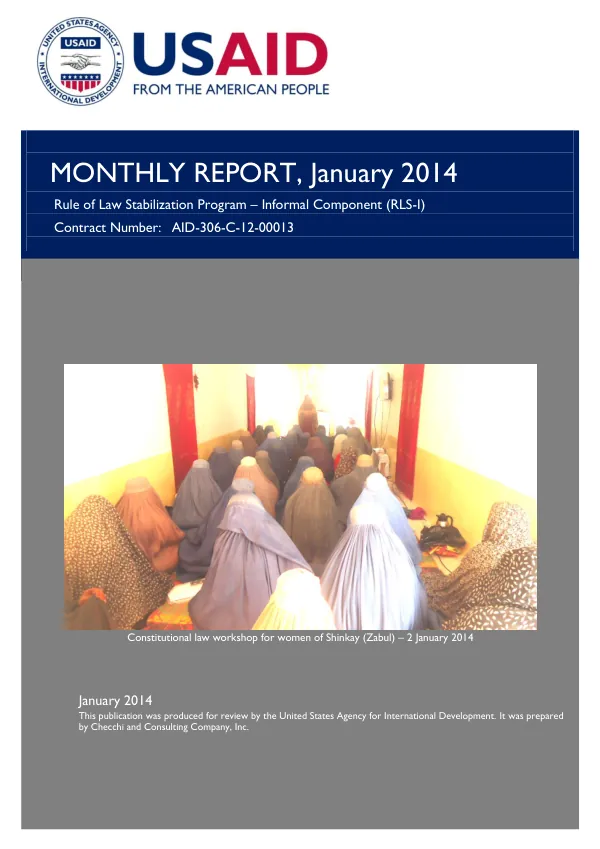
The program's objectives include improving and strengthening the traditional dispute resolution system, bolstering collaboration between the informal and formal justice systems, and supporting cooperation for the resolution of longstanding disputes. RLS-I assesses the strengths and weaknesses of the local justice environment in each new district prior to commencing activities. The program engages a geographically and tribally representative group of approximately 250 respected male and female elders and other public and religious leaders in legal awareness and solutions-based programming. The 12-month district intervention consists of a six-month core program of coalition-building network meetings, legal education workshops, solutions-based discussion sessions, and formal-informal justice protocol coordination meetings. In January 2014, RLS-I continued core programming and maintenance events in 13 existing districts, graduating ten of those from the RLS-I program. This brings the number of current RLS-I active districts to 23 while totaling 48 districts for the life of the project. RLS-I also continued mentoring program subcontractor The Liaison Office (TLO) and concluded cooperation with subcontractor the Peace Training and Research Organization (PTRO) in their implementation of core RLS-I programming for the first participant groups in the North. RLS-I's monitoring and evaluation (M&E) field staff documented spinsary decisions, identified longstanding disputes, and tracked decision book usage across districts in all regions. Security for RLS-I staff and participants remained an increasing concern, with RLS-I security reporting increased levels of credible threats being made to Afghan nationals thought to be working with international organizations. In the East Region, RLS-I's Maydan Wardak team completed all makeup workshops for Nirkh and Maydan Shahr, achieving attendance targets for the districts. The team also furnished jirga halls in Nirkh and Maydan Wardak and supplied them with over 200 legal and general education books each. Participants volunteered to continue disseminating RLS-I messages to other elders and the general community, and signed pledges to adhere to best practice in TDR. In the South Region, RLS-I's Kandahar team conducted a constitutional law workshop for women of Shinkay, with 1056 female participants attending. The workshop aimed to empower women to exercise their legal rights and encourage greater female participation in dispute resolution processes. RLS-I's Zabul team also conducted a family law workshop in Maydan Shahr, with 387 participants attending. RLS-I's North Region team continued mentoring program subcontractor The Liaison Office (TLO) and concluded cooperation with subcontractor the Peace Training and Research Organization (PTRO) in their implementation of core RLS-I programming for the first participant groups in the North. RLS-I's Badakhshan team furnished jirga halls and supplied them with over 200 legal and general education books each. RLS-I's public outreach campaigns reinforced RLS-I messaging and created public demand for improved justice practices. A training-of-trainers (ToT) for select community members equipped community legal awareness mentors to continue disseminating RLS-I lessons independently, demonstrating a clear commitment by local stakeholders to sustain the learning component of RLS-I.