USAID DEC
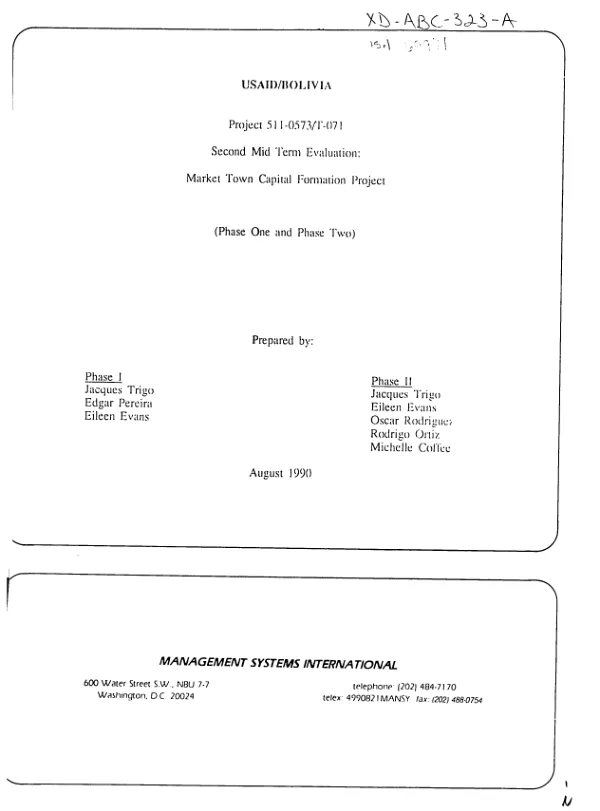
Rural development planning (RDP)/departmental development corporations (DDCs)/market town capital formation (MTCF)
Sign inUSAID. MISSION TO BOLIVIA
Rural development planning (RDP)/departmental development corporations (DDCs)/market town capital formation (MTCF)
Summarizes attached evaluation (XD-AAZ-292-A), which serves as a final evaluation of the Rural Development Planning Project (RDP) and the Departmental Development Corporations Project (DDC) as well as an early mid-term evaluation of the Market Town Capital Formation Project (MTCF).
1989
Sign in to readA free account is required to download.
Abstract
The rediscount line under MTCF provides credit for productive private sector investment in Bolivia"s rural and semi-urban areas. The project also provides TA to subproject loan recipients. To a large extent the RDP and DDC Projects formed the foundations for the MTCF Project. In fact, the loans extended under the DDC project are part of the MTCF portfolio. Timing for the mid-term evaluation was advanced due to concern over the slow movement of loans under the MTCF project and questions regarding its financial viability and self-sufficiency. While 30 loans have been approved, MTCF is significantly behind schedule. Other findings are: the overall system lacks clear lines of authority and permanence; project management is weak and not results-oriented; there is excessive focus on the creation of market towns; geographic and subsectoral restrictions limit success; red tape and bureaucracy are excessive; and self-sufficiency by 1989 is not attainable. A fundamental project need is to increase the level of productive investment everywhere in Bolivia and not exclude urban areas from access to credit. Other recommendations are to emphasize small and medium investors while not excluding larger entrepreneurs, and to conduct the market town activity as a pilot project. One of the key lessons learned is that in order for a private sector project to be effective, it must be founded on free market principles. The MTCF project has aimed to increase the level of productive private sector investment, but it has lacked a free market orientation. The project has promoted private investment, restricted it to rural and semi-urban areas, and utilized the private commercial banking system to channel rediscount lines. In a sense, it has tried to force investment into areas where it would not necessarily or naturally go, utilizing institutions that have a short-term, commercial, and adopting an urban focus rather than one which is long-term, developmental, and rural. These factors, combined with weaknesses within the implementing agencies themselves, led to the creation of a bureaucracy to guide and manage the process. These developments were understandable and these comments do not mean to imply that efforts to increase rural investment, to utilize private commercial banks, and to modify their practices are not worthwhile. Rather, they intend to convey that emphasis has been placed on oversight, and oversight through bureaucracy rather than through strengthening existing agencies (intermediate credit institutions). In addition, procedure has often overtaken the main objective: loan placement and subproject development - in essence, the provision of credit and TA to the private sector. Finally, the project has tried to accomplish, at the same time, two essentially contradictory functions: investment promotion (a costly and basically public sector effort) and sustainability (through reflows on loans which have been severely restricted in terms of geography and sectors thus preventing the financing of more profitable endeavors). (Author abstract, modified)
Related documents
Documents in this collection
 1989
1989USAID DEC
Bolivia - final evaluation -- rural development planning project, and departmental development corporations project : mid-term evaluation -- market town capital formation project
Open record 1990
1990USAID DEC