USAID. MISSION TO BOLIVIA
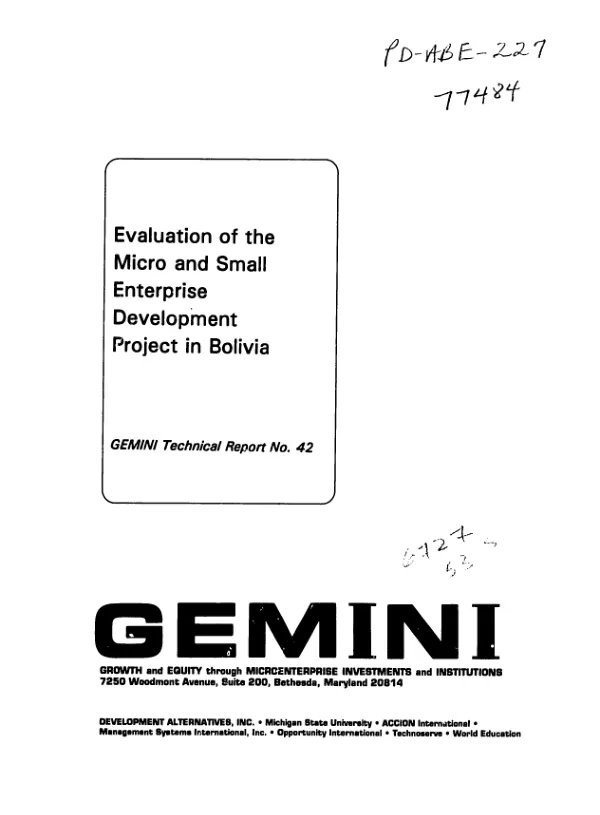
Micro and small enterprise development project
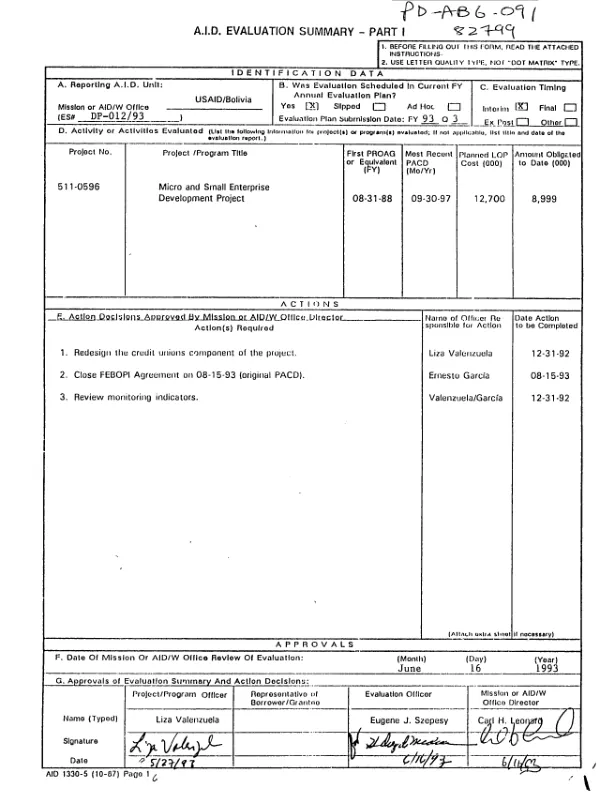
Summarizes a midterm evaluation (PD-ABE-227) of a project to develop Bolivia"s small enterprise sector through credit, training, TA, and policy research.
1993
Sign in to readA free account is required to download.
Abstract
The evaluation addresses the achievements of the three implementing PVOs -- the Bolivian National Federation of Small and Micro Enterprises (FEBOPI); the Bolivian National Federation of Credit Unions (FENACRE); and the Bolivian Foundation for the Development of the Micro Enterprise Sector (PRODEM). FEBOPI has established itself as an advocate of the small and micro business sector in Bolivia, raising awareness within the government and public of the problems facing the sector, and urging the Government of Bolivia (GOB) to remove these constraints. For its members, FEBOPI has run an extensive training program in business skills through its eight affiliated organizations known as ADEPIs. It has also helped the GOB organize successful trade fairs. In spite of FEBOPI"s efforts, no substantial reforms have taken place. Furthermore, FEBOPI"s membership is small relative to its potential clientele and is declining (due in part to an increase in dues). Not yet an established institution, FEBOPI should build a more effective service menu in order to increase its membership and become self-sufficient. FEBOPI"s reporting systems also need major improvements. Lessons learned from FEBOPI are: (1) Project designers should be conservative in areas such as microenterprise development in order to avoid unrealistic expectations. (2) Because beneficiary organizations tend to put off developing self-sufficiency plans until they are imminently needed, a timetable and methodology for achieving self-sufficiency should be part of every new project. The FENACRE component of the project has not been implemented, given the fact that FENACRE was insolvent. It is recommended that FENACRE be scaled down and adopt the role of a purely representational organization, coordinating information to and from credit unions, and lobbying the GOB on their behalf. The TA under this component should be directed toward the credit unions rather than FENACRE. Recent experience in Bolivia demonstrates that credit unions can be successful in the mobilization of their own loanable funds. They do, however, require assistance in upgrading their financial intermediation technology. Greater emphasis should be placed on institutional strengthening based on deposit mobilization rather than on external credit. Some lessons learned from FENACRE are as follows. (1) Project design teams must be required to provide a high level of in-depth financial analysis of institutions such as FENACRE, because superficial analysis leads to serious misrepresentation of financial health. (2) Second level representation organizations, such as FENACRE, that function as intermediaries develop objectives of their own that are often in conflict with its member institutions. The political control structure creates serious conflicts of interest, undermining its role as intermediary. PRODEM was transformed into BancoSol, the first private sector bank in the hemisphere dedicated to lending to, and mobilizing deposits from, the small and micro business sector. BancoSol appears to be progressing satisfactorily, but needs continuing technical assistance in banking technology, especially to reduce the costs of transactions on small loans. The success of BancoSol suggests the USAID should take a flexible approach to institutional development as it did with PRODEM. Although not apart of the original project design, USAID assisted the transition which resulted in a stronger organization with more resources to serve the microenterprise sector. Lessons learned from PRODEM are as follows. (1) The solidarity group methodology has worked well, and seems appropriate for micro-entrepreneurs in commerce and for small producers. Lack of bureaucratic control and of unwanted interference, together with freedom to form their own groups and to restructure groups, has resulted in low delinquency. As micro-producers grow and need larger loans, PRODEM/BancoSol may want to consider diversifying its methodology and giving individual loans. (2) PRODEM"s institutional culture and team management, characterized by teamwork, participatory decisions, developed interpersonal skills, and commitment, have played a key factor in its ability to transform into a bank.
Related documents