USAID. MISSION TO INDONESIA
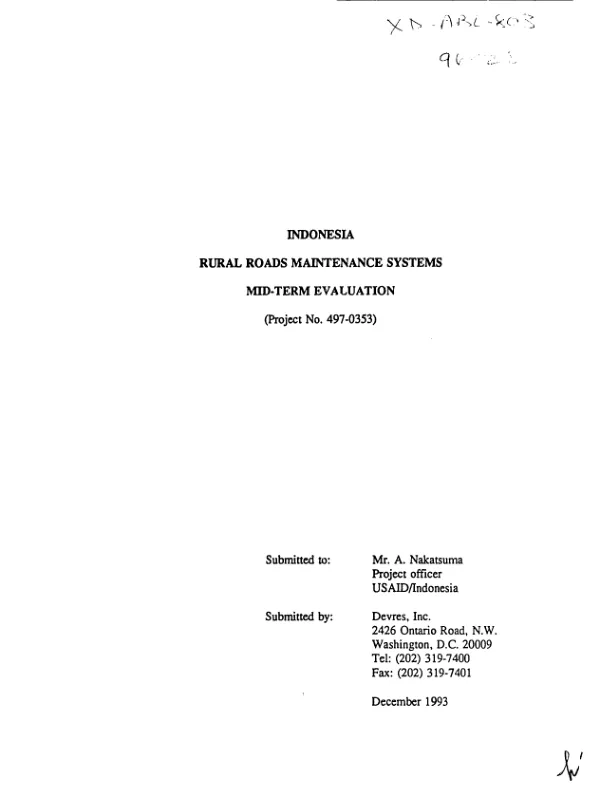
Rural roads maintenance systems
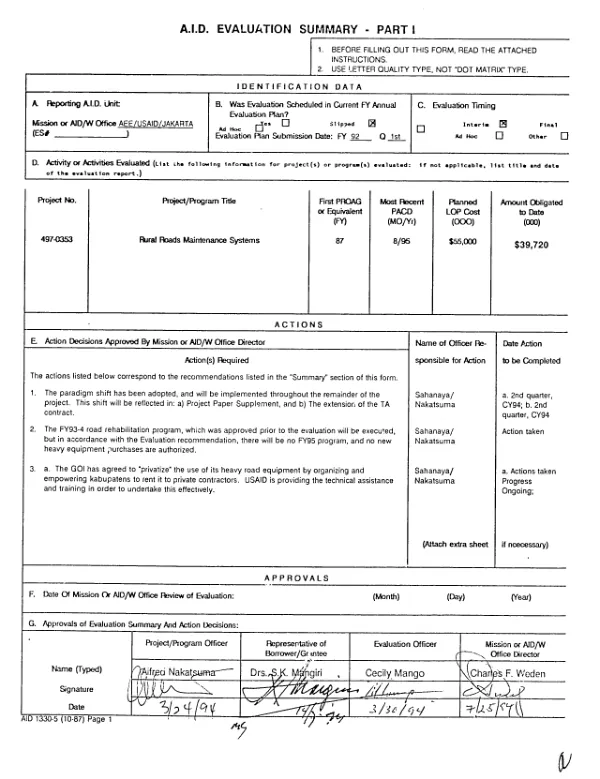
Summarizes attached interim evaluation (XD-ABL-803-A) of a project to assist the Government of Indonesia (GOI) in institutionalizing sustainable rural roads maintenance systems in nine districts.
1994
Sign in to readA free account is required to download.
Abstract
The evaluation covered the period 6/87-1/94. Project accomplishments include development and partial testing of systems and manuals covering much of the range of project activities -- equipment maintenance systems, highway maintenance systems, road link selection procedures, tendering and contracting procedures, and road work certification procedures. Limited amounts of road rehabilitation, workshop construction, and training have also taken place. The major flaw in an otherwise sound project design was that road rehabilitation was included as a "necessary" activity. While seen as no more than a means towards the end of creating a supply of maintainable roads, it had the unintended consequence of diverting attention away from maintenance, institutionalization, and sustainability, a flaw greatly exacerbated in the course of project implementation. There have also been shortfalls in project implementation; maintenance awareness is still low in both BANGDA (the Ministry of Foreign Affairs) and the districts and little is performed while rehabilitation remains dominant, implementation has been sluggish, institutionalization and sustainability are questionable, communication among the parties is lacking, training has been deficient, GOI budgetary problems have not been adequately addressed, and other donor coordination has been insufficient. Rehabilitation will cover only 1/3 of the km projected. Despite these problems, the evaluation team believes that a good foundation has been laid and that the project will be a substantial success. Lessons learned are as follows. (1) The potential value of the systems and manuals produced by the project is substantial, but could be lost without an adequate training program to refine and disseminate them. (2) Roads already rehabilitated under the project are at risk of deterioration and the district"s understanding of the importance of maintenance is in danger of being lost by the incomplete status of project activities. (3) Institutional development projects are best implemented by organizations specializing in the area, rather than by technically oriented firms. (4) Such projects also need earlier and more frequent external evaluations than do projects producing a relatively easily measured physical output. (5) Road rehabilitation and equipment purchases are of less value to maintenance system institutionalization and sustainability than training and institutional support. (6) Although it has been lacking in the project, adequate data are essential for operational efficiency and economic justifiability. (7) Coordination with other donors is essential to ensure optimum benefits to donors and host country alike. (8) The use of Project Management Units (PMUs) is sound in light of manpower limitations imposed upon USAID. Had one been instituted at the time of project authorization, it would have done much to relieve the burden of implementation.
Related documents